
Address
6. October, Cairo, Egypt

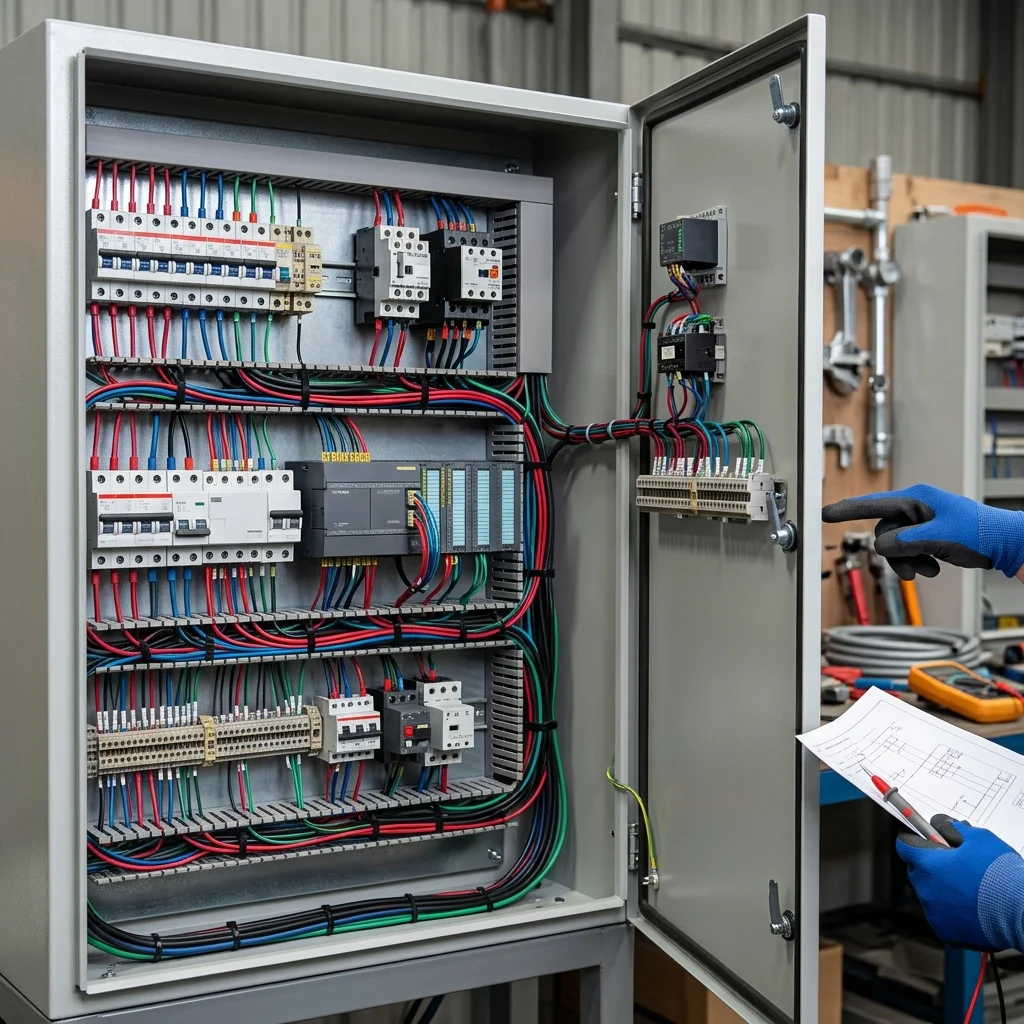

An industrial control panel is the part of a production line that nobody photographs and everybody depends on. It holds the controller, the power distribution, the drives and the wiring that turn a pile of machines into a line that starts, runs, stops and reports. Yet it is often specified in a single sentence at the bottom of an equipment order: “control panel to suit”. The result is predictable. Panels arrive in the wrong material for a washdown area, without spare capacity, with drawings that do not match what was built, or from three suppliers in three different styles.
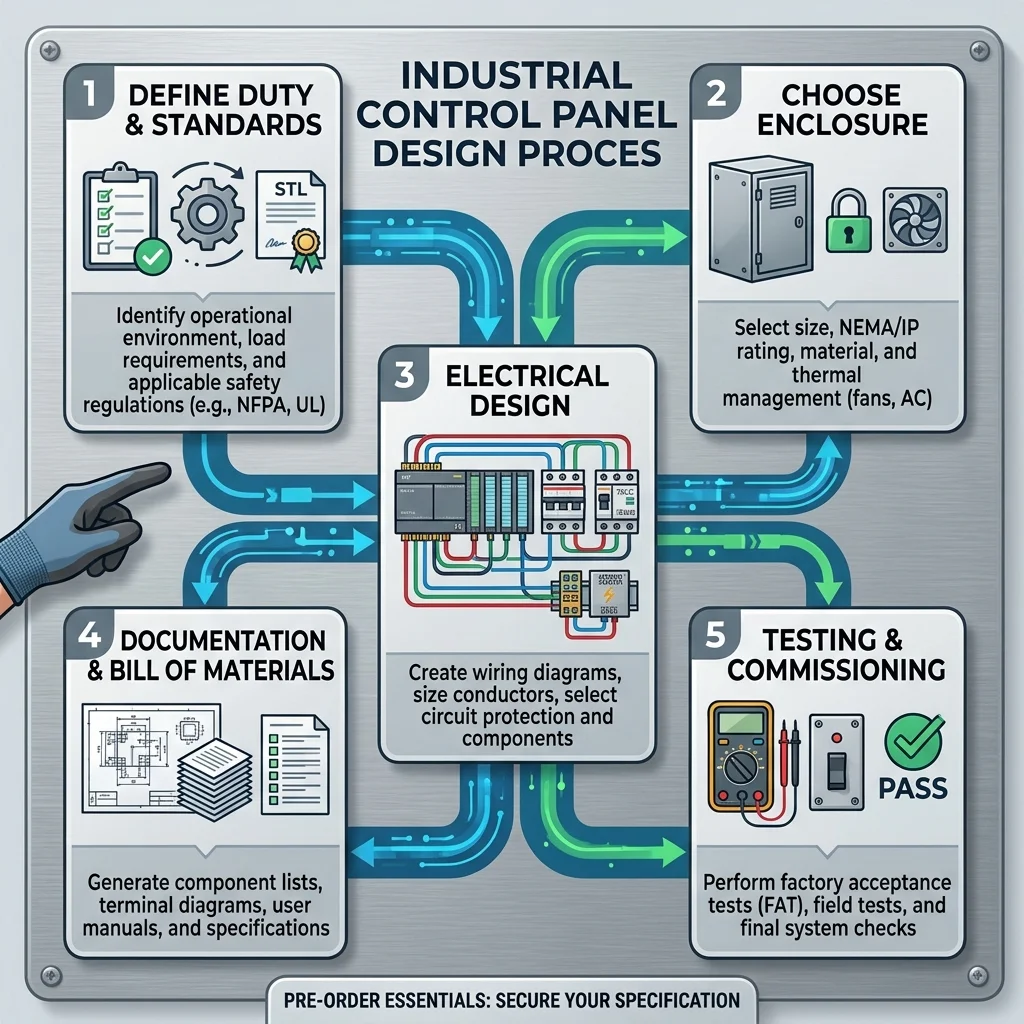
This guide explains what to include when you specify an industrial control panel for a food, beverage or similar process plant: how to define the duty, which standards to reference, how to choose the enclosure and the electrical design, what documentation to ask for, and how the panel should be tested before it reaches site. It is written for owners, plant managers and project engineers who need to write, compare or approve a panel specification.
What an Industrial Control Panel Is
An industrial control panel is an enclosure that groups the electrical and control equipment for a machine or process area. A typical industrial control panel contains incoming power protection, power distribution to motors and heaters, variable-speed drives, a programmable logic controller (PLC), input and output modules, relays, power supplies for control voltages, terminals for field wiring and, often, an operator interface. One technical reference describes control panels for industrial automation as integrating a PLC, drives, input and output modules, networking and an HMI.
In a process plant, an industrial control panel comes in several types: motor control panels, PLC panels on skids or machines, local operator stations, remote input and output cabinets and, in larger plants, main control or switchgear rooms. How these layers relate to the controller and the supervisory system is covered in our guide to PLC, SCADA and HMI. Our industrial automation and control page describes how the control scope is organised in an engineering project.
Start Industrial Control Panel Specification With the Duty
A useful industrial control panel specification starts with what the panel has to do, not what it has to be made of. Write down the duty first.
Which equipment will it control, and what are the electrical loads, voltages and motor sizes? How many inputs and outputs are needed, of what types, and how much spare capacity should be left for changes? Which sequences and interlocks must it run? Which networks must it join, and with which other machines or systems? What does the operator need to see and do at the panel? And where will it be installed: a clean control room, a production area or a wet, hot, washed-down space?
Duty drives every other choice in an industrial control panel specification, and incomplete duty statements are the most common cause of panels that have to be reworked on site. A project team that can answer these questions in a page has already prevented most of the problems this article describes.
Standards for an Industrial Control Panel Specification
A specification should name the standards the industrial control panel must meet, so that suppliers price the same thing. A technical reference from an automation distributor describes three main frameworks: UL 508A for industrial control panels in North America, NFPA 79 for electrical equipment of industrial machines, and IEC 61439 for low-voltage switchgear and controlgear assemblies in global markets. The same source notes that in the EU the equivalent pairing is IEC 61439 for the assembly and IEC 60204-1 for the machine’s electrical equipment, and that enclosures are specified by NEMA type or by IP code under IEC 60529.
Which framework applies to an industrial control panel depends on where the equipment is installed, who supplies the machine and what the authority having jurisdiction or the customer requires. Many projects outside North America refer to IEC standards, but this is a decision for the project, not an assumption. State the applicable standards and the markings and test evidence you expect, and ask suppliers to confirm compliance in writing.
Enclosure Choices for a Food Plant Industrial Control Panel
The enclosure is the first thing a food plant should specify carefully, because the room it sits in determines what it must withstand. The same technical reference gives typical pairings: clean, dry indoor locations such as control rooms use ratings equivalent to about IP54, while washdown areas in food and beverage plants typically use NEMA 4 or 4X, roughly equivalent to IP66. It cautions that the cross-reference between NEMA and IP is approximate, and that corrosive environments may call for 316 stainless steel.
For a washdown area, the industrial control panel specification should state the required ingress protection, the enclosure material and finish, the door sealing and hinges, how cable entries will be sealed and what happens to condensation. An industrial control panel placed where staff hose down equipment needs a design that sheds water and can be cleaned without opening it, and sloped tops and smooth surfaces help. Material choice interacts with cleaning chemicals; our guide to 304 versus 316L stainless steel explains how chlorides and sanitisers affect the choice.
Heat matters too in an industrial control panel. Drives and power supplies generate heat that has to leave the enclosure without breaking the seal. The same reference warns that cooling calculations must account for the enclosure rating, and that adding louvers voids it. If panels must be cooled in a wet area, ask the supplier to show the thermal calculation and the cooling method, rather than assuming it will work.
Location is the cheapest way to reduce risk for any industrial control panel. Where possible, move panels out of the wet process area into a clean, ventilated room, and run field cables to them. Our industrial utilities page covers the services that surround such rooms.
Electrical Design: What to Specify?
Beyond the enclosure, the industrial control panel specification should describe the electrical design in enough detail that suppliers cannot interpret it differently.
Power supply and protection. State the incoming supply, the voltage levels needed for power and control, the protective devices and the short-circuit ratings. Short-circuit rating deserves explicit attention: the reference notes that UL 508A requires a short-circuit current rating on the nameplate, and IEC 61439 emphasises design verification through tests such as temperature rise and short-circuit withstand. Whatever the framework, the panel’s rating must be sufficient for the fault current available where it is installed, and someone must confirm that figure.
Drives and motor control. Specify the motors, how they start and stop, whether variable-speed drives are needed, and how drives and motors are cabled and earthed. Ask for the drive and filter arrangement to follow the manufacturers’ installation guidance.
Earthing, segregation and layout. Ask for a clear earthing scheme and for separation of power, control and signal wiring so interference does not corrupt measurements. The reference identifies thermal, electrical clearance and service access as the three constraints driving layout, which is a useful way to frame the requirement.
Spare capacity. Specify spare input and output points, spare terminals and spare space in the enclosure. Plants change, and an industrial control panel with no room is one that will be replaced.
Controls and Communication Requirements
An industrial control panel is also a computing and communication device, so the specification should cover its control hardware. State the preferred PLC and drive platforms, or the criteria for choosing them: compatibility with the plant’s existing systems, availability of local support and spare parts, and the maintenance skills the plant has. Define the communication networks, addressing and protocols, and how the panel will exchange data with other machines and with the plant’s supervisory system. Define the operator interface: its size, location, languages, alarm handling and access levels.
Decide who writes and owns the PLC program, how recipes and parameters are stored, and what documentation of the software is delivered. Cybersecurity belongs here as well: agree how the panel connects to plant networks and remote access, and who is responsible for updates and backups after handover.
Layout, Wiring, Marking and Documentation
The quality of an industrial control panel is visible when a technician opens it at two in the morning. A good specification asks for orderly layout, accessible terminals, correct wire sizing and consistent marking. The reference lists wire numbering matching the schematic at every termination, cross-references between schematic and mechanical drawings, a bill of materials with manufacturer and part numbers and an installation, operation and maintenance manual among the documentation expected, and notes that panel inspectors will reject handwritten wire markers or terminal labels.
Ask for documentation as a defined deliverable: electrical schematics, enclosure layout drawings, terminal and cable schedules, a bill of materials, PLC and HMI program backups, datasheets and manuals, and test records. Insist on as-built drawings that match what was delivered. These documents are often the difference between a panel the plant can maintain and one that is dependent on its supplier.
Testing, Factory Acceptance and Commissioning
Specify how the industrial control panel will be proven before it is energised in the plant. The reference describes factory acceptance testing as typically including checks such as wire continuity against the wiring list, insulation resistance and dielectric tests, and the same source gives example test values. Those values depend on the framework and the equipment, so take them from the applicable standard and the supplier’s procedure instead of copying figures from a general article.
A sensible approach has three stages. A factory acceptance test checks construction, wiring, power-up and, where possible, the logic with simulated inputs. A site acceptance test checks the panel connected to real equipment. Commissioning then runs the sequences, interlocks and alarms on water and finally on product. Our commissioning page describes how that stage is organised. Include in the specification who attends each test, what documents are signed and what happens if a test fails.
Responsibilities and Interfaces
Every industrial control panel sits on a boundary. Write down who supplies the enclosure, who designs the circuits and software, who builds and tests the panel, who installs and wires the field devices, who terminates the cables at the panel and who commissions the result. Where machines arrive with their own panels, agree how they connect to the plant network and the main supply. Where the panel interfaces with cleaning or utilities, such as CIP valves or steam control, ensure the signals and interlocks are defined; our CIP systems page treats those controls as part of the cleaning scope.
An Illustrative Scenario
Consider a hypothetical plant that orders a PLC panel for a new filler with the note “stainless steel, IP65”. The panel arrives and is installed beside the filler. Within a few weeks, wash-down water finds its way in through a cable gland and a poorly sealed door, and the drive overheats because the panel was sized with little spare heat dissipation. The panel was built exactly as specified. The specification was thin: no thermal calculation, no cable-entry requirement, no location rule. Moving the panel into a clean room and running longer cables would have cost less than the repairs. A one-page duty statement and environment description would have caught all of it. That is what a proper industrial control panel specification does.
Common Mistakes in Industrial Control Panel Specification
A few mistakes recur in industrial control panel specification. Specifying the panel without describing its duty or environment. Naming no standards or test requirements. Choosing the enclosure for price instead of the room. Leaving no spare capacity. Ignoring heat. Not defining who owns the software and documentation. Accepting drawings that do not match the panel. And scheduling no factory acceptance test.
Five Checks Before You Issue an Industrial Control Panel Specification
Before issuing a specification, ask:
- Does it describe the duty, loads, inputs and outputs, networks and environment?
- Does it name the applicable standards and the evidence expected?
- Is the enclosure rating, material and cooling matched to the room?
- Are documentation, software ownership and spare capacity defined?
- Are factory acceptance, site acceptance and commissioning planned and assigned?
FAQ: Industrial Control Panel Specification
What should an industrial control panel specification include?
The duty and loads, standards, enclosure and environment, electrical design and protection, control hardware and networks, documentation, testing and responsibilities.
What enclosure rating suits an industrial control panel in a washdown area?
Technical references commonly pair washdown areas in food and beverage plants with NEMA 4 or 4X, roughly equivalent to IP66, but the right rating depends on how the area is cleaned. Confirm it for your site.
Who owns the PLC program in an industrial control panel?
It should be agreed in the contract. The owner normally needs the programs, drawings and documentation at handover so the plant is not dependent on a single supplier.
Do I need a factory acceptance test for an industrial control panel?
It is strongly recommended. A factory test finds wiring and logic faults before the panel reaches site, where fixing them is slower and more expensive.
Specify the Panel Before You Order the Machine
A well-specified industrial control panel is mostly the result of questions asked early. If you are planning a new line, an expansion or an automation upgrade and want an engineering team to discuss panel duty, environment, documentation and testing, read about our industrial automation and control capabilities or contact our engineering team to talk through your project.