
Address
6. October, Cairo, Egypt


Most installation delays are decided before the first crate is opened. A truck arrives with a pasteurizer, a set of tanks or a filler, and the site turns out not to be ready: the floor is not cured, the steam tie-in is a metre from where the drawing says, the doorway is narrower than the skid. A reliable production line installation checklist exists to catch those problems while they are still cheap to fix.
This guide walks through a practical production line installation checklist for food, beverage and similar process plants. It is written for plant managers, project engineers and owners who want to know what must be true on site before equipment is delivered, who should confirm each item, and where installations most often stumble.
Why a Production Line Installation Checklist Starts Before Delivery?
People tend to picture installation as the moment equipment is lifted into place. In reality that is the middle of the job. The work that decides whether installation goes smoothly happens earlier, in the form of drawings, civil works, utility preparation and decisions about who does what.
A good production line installation checklist therefore works backwards from delivery day. It asks what the crew will need on the morning the first skid arrives, then checks each of those needs against the real state of the building. Power available? Water at the right point? A clear path from the unloading area to the final position? Lifting equipment booked? Each answer is a yes, a no or a “we think so”, and the third kind deserves the most scepticism.
We treat the production line installation checklist as a shared document between owner, installer and equipment suppliers rather than a private to-do list. When only one party holds it, the items that belong to someone else quietly drop off. When everyone can see it, the gaps become visible while there is still time to close them.
It also helps to separate readiness from installation scope when you build a production line installation checklist. Our production line installation service describes what an installer can deliver; the checklist in this article covers what the site has to provide first, whoever ends up doing the work.
What a Production Line Installation Checklist Must Cover?
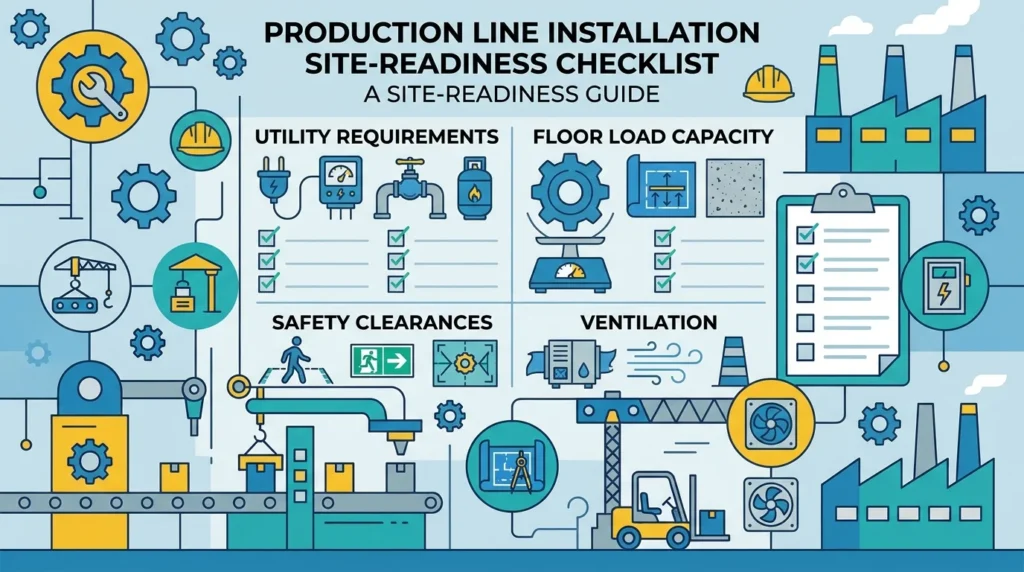
Whatever the product, a production line installation checklist tends to sort into five groups: the building and civil works, the utilities, access and handling, documentation, and safety and site rules. The items inside each group change with the line, but the groups rarely do.
Civil and building readiness
The first block of any production line installation checklist is the floor, because everything sits on it. Equipment suppliers normally state the loads their machines place on the floor, the flatness they need and whether anchors, plinths or special drains are required. Compare those statements with the real slab. Is the concrete finished and properly cured? Are floor falls and drain positions matching the layout? Are plinths, trenches and pits built where the drawings place them?
Then look up. Roof height, structural supports for piping and platforms, ventilation and lighting all affect what can be installed and how. Then look sideways: wall openings, partitions, hygienic finishes where the process requires them. A hygienic plant often needs surfaces and drainage that can be washed down; a dry plant may not. The point of this part of the production line installation checklist is to compare what the equipment needs with what the building actually offers, in writing, before work begins.
Utilities readiness
Utilities are the most frequent source of late surprises on a production line installation checklist. A line may arrive intact and still wait weeks because the services it needs are not there. Typical services include electrical power, water of the required quality, steam, compressed air, chilled water, drainage and, in many food plants, a CIP supply and return.
For each utility, the production line installation checklist should record the required capacity, the pressure or temperature, the tie-in location and who is responsible for the connection. It should also say whether the existing source can actually carry the extra load. A boiler that serves the current plant comfortably may not carry a new line on top; a compressed-air plant may meet today’s demand and no more. Our guide to industrial utilities explains the main systems, and our mechanical, electrical and piping page describes how they are routed to the process.
Access, rigging and handling
Even a perfectly prepared building can frustrate an installation if the equipment cannot physically reach its position. Your production line installation checklist should include a measured path from the unloading point to the final location: gates, doors, corridors, turning radii, floor strength along the route and overhead obstructions. Large tanks and skids sometimes need openings created in walls or roofs, and those openings need planning, not improvisation.
Rigging deserves its own line on the production line installation checklist. Cranes, forklifts and lifting gear should be booked against the delivery schedule, with competent operators and a lifting plan for the heavier items. Storage matters too. If equipment arrives before it can be installed, where does it wait, and how is it protected from weather, dust and damage?
Documents and drawings on a production line installation checklist
The paperwork belongs on the production line installation checklist too. Before installation starts, the team should hold current layout drawings, equipment dimensional drawings, piping and instrumentation diagrams where they exist, electrical schematics, utility schedules and the manufacturers’ installation instructions. More importantly, someone should have reconciled them with each other. Connection heights on the equipment drawing need to match connection heights on the site drawing; otherwise the mismatch surfaces when a pipe fails to meet a flange.
Good practice, and one we follow on projects, is to keep a single controlled set of drawings and mark clearly which revision is current. Installation crews working from different versions create more rework than almost any technical problem.
Equipment-Specific Checks to Add to Your Production Line Installation Checklist
A generic production line installation checklist gets you most of the way, but each type of equipment adds items of its own.
For stainless steel tanks, confirm the support structure, the positions of nozzles and manways, access for cleaning and the route for connecting pipework. Our stainless steel tanks page covers the fabrication side. For pipework carrying product, positioning matters because the line needs to drain and clean properly; the European Hygienic Engineering & Design Group (EHEDG) publishes GL 10 on hygienic design of closed equipment for liquid food, which illustrates how to connect and position equipment so that draining and cleaning in place are not obstructed. These guidelines are regarded as best practice rather than legal requirements, so decide with your quality team which ones your plant will follow.
For controls, check that cable routes, cabinet locations and field-device positions are agreed, and that the people responsible for industrial automation and control know the sequence of work. A control cabinet delivered into an unfinished room is a reliable way to damage a control cabinet.
On a dairy plant project where our scope covered utilities, mechanical, electrical and piping systems and automated control panels, the practical lesson was about sequencing rather than technology: the trades needed each other’s work finished in a particular order, and the order had to be written down before anyone mobilised. Every production line installation checklist benefits from that discipline.
Who Signs Off Each Item
A checklist without owners is a wish list. Next to every item, record who is responsible, who confirms it and by when. Typically the owner or building contractor holds civil and building items, the utility provider or installer holds utility connections, the equipment supplier confirms what its machines require, and the installer confirms access, handling and sequence.
In a turnkey engineering arrangement, a single party coordinates most of these interfaces; in a split-contract arrangement, the owner usually coordinates them. Either way, the production line installation checklist should make the split explicit. Also decide who has the authority to say “not ready”. Projects slow down when nobody is willing to stop the delivery because a floor is not finished.
A Short Production Line Installation Checklist You Can Adapt
The full list will be longer, but five gates capture the logic of a production line installation checklist and help a project team test whether it is ready to proceed:
- Building and floor confirmed against the supplier’s requirements
- Every utility has a stated capacity, tie-in point and owner
- Delivery route, rigging and storage are planned and booked
- Drawings are current, reconciled and issued as one controlled set
- Responsibilities and sign-offs are recorded for every item
If any gate is open, delivery should wait or be rescheduled. A day lost to a late delivery is usually cheaper than a week lost to equipment sitting in the wrong place.
Gaps That Usually Appear Late
Some gaps recur often enough on a production line installation checklist to name. Utilities are the first, as already noted. The second is drainage: floor falls, drain capacity and wash-down requirements are easy to overlook until the first cleaning cycle. The third is access for maintenance; a line that can be installed but not serviced has been planned only half. The fourth is temporary services: during installation the crew needs power, light, water and sometimes compressed air, long before the permanent systems are live. The fifth is the interface between new and existing equipment, which is where upgrades often struggle.
Checking these early does not require exotic skills. It requires someone to walk the site with the drawings in hand and ask uncomfortable questions.
From Site Readiness to Commissioning
Installation is not the finish line. Once equipment is positioned, piped and wired, the work moves into testing and commissioning, where systems are checked individually and then together. A solid production line installation checklist feeds directly into that stage: the same drawings, utility records and sign-offs become the evidence that the line was built as intended. Our commissioning page describes how that stage is organised.
If your project is still at the planning stage, our companion article on how to plan a turnkey food production line explains how scope and interfaces are defined before site readiness becomes the issue.
FAQ: Production Line Installation Checklist
What should a production line installation checklist include?
A production line installation checklist should cover building and floor readiness, utilities, access and rigging, drawings and documents, and safety and site rules, with a named owner and sign-off for each item.
When should the production line installation checklist be completed?
Before equipment delivery, and ideally while the layout is still being finalised. Items that are open at delivery time usually become delays.
Who is responsible for site readiness?
It depends on the contract. In a turnkey arrangement one party coordinates readiness; in a split-contract arrangement the owner normally does. The responsibilities should be written into the production line installation checklist itself.
Is a production line installation checklist different for each industry?
The main groups are the same, but the details change. Food and dairy lines add hygienic design, drainage and CIP interfaces; other industries add their own process requirements.
Prepare Your Site Before the Equipment Arrives
A production line installation checklist will not make a project effortless, but it moves surprises to the point where they cost the least. If you are planning a new line, an expansion or an upgrade and want a second set of engineering eyes on site readiness, our team can review the scope with you. Read about our production line installation service, or contact our engineering team to discuss your project.