
Address
6. October, Cairo, Egypt

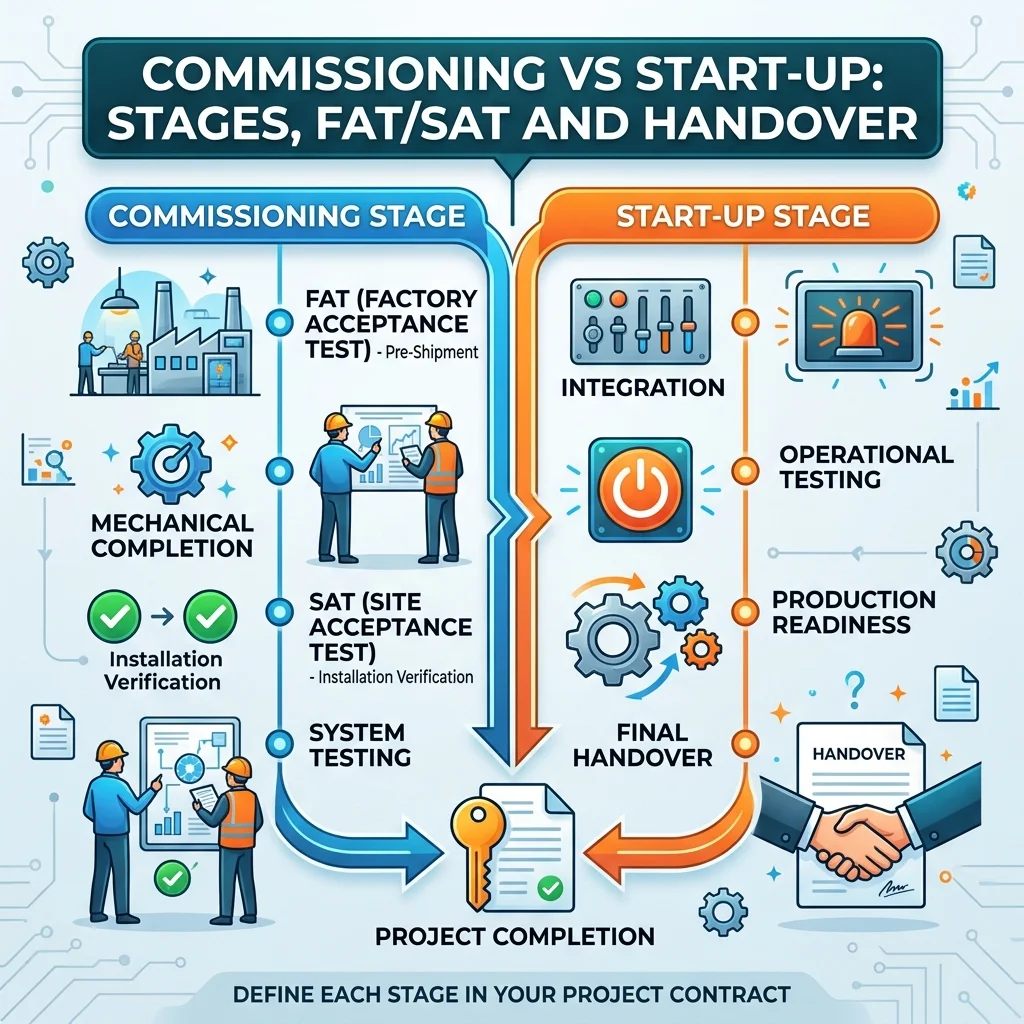

Ask five people on a project what the difference is between commissioning and start-up and you may get five answers. For some, the two words mean the same thing: commissioning is simply the stage where the plant is brought to life. For others, start-up is the dramatic moment when product first flows, and commissioning is everything careful that happens before it. Both views are defensible, and the confusion is costly, because a contract that does not define the terms leaves the most expensive stage of a project without clear ownership.
This guide explains commissioning vs start-up in practical terms for food, beverage and similar process plants: how the stages usually run, what factory and site acceptance tests are for, what a proper handover contains, and how to write the responsibilities into the project so nothing falls between the installer, the equipment suppliers and the plant’s own team. It is written for owners, plant managers and project engineers who will sign the contract and live with the result.
Commissioning vs Start-Up: Why the Words Matter
Different industries and companies use the terms differently, and the sources show it. One checklist publisher notes that pre-commissioning is sometimes called cold or static commissioning or mechanical completion, while commissioning is sometimes called hot or dynamic commissioning, or start-up. In that usage, the two are near-synonyms for the live stage. Other guides separate them. A handover guide from the consulting firm iFactory describes commissioning as verifying that installed systems work as designed, start-up as introducing process material to reach first production, and handover as the formal transfer of the asset from the project team to operations.
An equipment engineering firm’s guide describes a similar sequence: installation covers physical placement and connections, pre-commissioning is cold verification before start-up, such as loop checks, calibration and hydrotests, and start-up then moves commissioned equipment toward stable operation under intended production conditions, including trial runs, performance testing and handover.
The practical conclusion is not to pick a winner but to define the terms in your contract. When you write commissioning vs start-up into the scope, say what each stage includes, what it starts and finishes with, who performs it and what evidence closes it. Our commissioning page describes how this stage is organised in an engineering scope.
The Stages From Installation to Handover
Whatever labels are used, projects tend to pass through a recognisable sequence.
Mechanical completion
Mechanical completion marks the end of construction and installation. A commissioning guide from Commissioning and Start-Up describes it as the point at which equipment is installed and a formal handover process confirms that it has been installed per the design, with marked-up as-built drawings delivered to the commissioning team and a deficiency list generated, with serious deficiencies rectified before pre-commissioning begins. A conference presentation on process plants adds that a mechanical completion certificate is typically issued for each utility and process unit. In practice, this is also the point where the installer hands the plant to the people who will test it; our production line installation page covers the stage that precedes it.
Pre-commissioning
Pre-commissioning, also called cold commissioning, verifies the plant before process material is introduced. The same guide says that for mechanical systems, pre-commissioning consists of cleaning and flushing pipes, pressure testing and leak testing. For electrical and control systems it includes checks, calibration, loop checks and verification of input and output signals. Process plants often add chemical cleaning, equipment alignment and run-in tests. Because plants are large, they are usually divided into system packages, each pre-commissioned as a whole with isolations kept at the boundaries until the work is complete.
For a food or dairy plant, pre-commissioning is also where utilities and cleaning circuits are first proven: steam, water, compressed air and cooling brought into service, then CIP circuits flushed and verified. Our industrial utilities and CIP systems pages describe those scopes.
Commissioning proper
Commissioning is the stage at which systems are tested working together. The Commissioning and Start-Up guide describes it as the on-site process to verify that equipment has not been damaged during shipping and operates as designed, then integrates subsystems to form the process and tests them as a system. In a food plant, this usually means running sequences and interlocks on water first, adjusting controls, checking alarms and safety functions, and running cleaning cycles, so that problems are found while the product is still water.
Start-up and performance runs
Start-up introduces product. The conference presentation describes it for a process plant as bringing utilities into service, introducing raw materials and producing the required grades of product. In a food or beverage plant, that means product trials, adjusting recipes and parameters, running at planned rates and demonstrating that the line makes acceptable product. Whether performance runs are formal acceptance tests or practical ramp-up depends on the contract.
Handover
Handover is the formal transfer from project team to operations. The iFactory guide frames it as including documentation, training and acceptance. For a plant, that typically means as-built drawings, test records, equipment manuals, spare parts lists, control software and backups, certificates and warranty information, operator and maintenance training, and a list of any outstanding items with owners and dates.
FAT and SAT: What Each Is For
Factory acceptance tests (FAT) and site acceptance tests (SAT) are two of the most useful milestones in a handover plan, and they are often misunderstood.
A FAT is carried out at the supplier’s premises before equipment ships. One robotics integrator’s guide describes it as verification of build quality, controls, safety logic and basic process performance prior to shipment, producing a report with open points and shipping authorisation. A SAT is carried out at the customer’s site and validates performance with real interfaces, operators, materials and production conditions. The same guide notes that problems that should have been found during a FAT become expensive during a SAT, and that the best programmes tie each acceptance point to a written requirement, a test step and a named owner.
A technical competency document on process control points out two further things. A FAT is useful in protecting the business side of an investment, and, if a FAT is provided, the SAT can be a reduced regimen, although changes made after the FAT, outside a controlled setting, could affect the outcome. For a package such as a control panel, a skid or a pasteurizer, FAT and SAT are the formal evidence that the equipment works before and after it is connected to your plant. Our industrial automation and control page covers the control side of those tests.
Writing Commissioning vs Start-Up Into the Contract
The cleanest way to avoid disputes is to write the stages into the contract in plain language. Define what each stage includes and excludes. Define the evidence required to close each one: test records, signed certificates, punch list status. Define who performs, who witnesses and who accepts. Define how defects found are classified and cleared. Define what happens if a test fails: who fixes, who pays and who retests. And define how the responsibilities of equipment suppliers, the installer and the plant’s own staff fit together.
This is also where the arrangement of the whole project matters. In a turnkey engineering arrangement, one party coordinates commissioning across suppliers. In a split-contract arrangement, the owner usually does. Either way, the contract should name the person who owns the integrated plan. Our earlier guides on the planning side, including the one on how to plan a turnkey food production line, explain how scope and interfaces are defined before this stage begins.
Planning the Live Stages Before You Install
Commissioning is easier when it is planned early. Reverse-planning from the target start-up date shows the order in which systems must be completed, so the installer can finish utilities and cleaning circuits first. Test procedures can be drafted from the design while equipment is still being built. Access, permits, utilities and temporary services for testing can be arranged in advance. And the people who will operate the plant can be identified early, so they can attend tests and training.
Water, drains and chemicals deserve special attention. Water trials need supply and drainage. CIP trials need chemicals and a way to verify results. Product trials need raw materials, packaging and laboratory support. Each of these should be on the commissioning schedule, with an owner.
Training and Documentation
Training is part of commissioning, not an afterthought. Operators and maintenance staff learn fastest while the people who built the plant are still on site. Plan sessions around the real systems, with the actual procedures, and record who attended. On projects where our scope has included commissioning and operator training, the consistent lesson is that the plant is easiest to hand over when training happens during commissioning, not after it.
Documentation is the other half. A handover package typically includes procedures, test records and certificates, as-built drawings, calibration records, software backups, manuals and spare parts information. Insist on it as a defined deliverable. The plant will depend on it for years.
An Illustrative Scenario
Consider a hypothetical plant whose contract says only “commissioning included”. The installer finishes piping and cabinets, runs each machine briefly and declares the line commissioned. The owner expects product trials, cleaning verification and operator training. The installer assumes those belong to the equipment suppliers, who assume they belong to the installer. For several weeks nobody owns the integrated line, while production waits. The equipment works. The contract never separated mechanical completion, pre-commissioning, commissioning, start-up and handover, or named an owner for each. A one-page stage definition would have prevented it. That is the practical value of settling commissioning vs start-up on paper.
Common Mistakes in Commissioning Planning
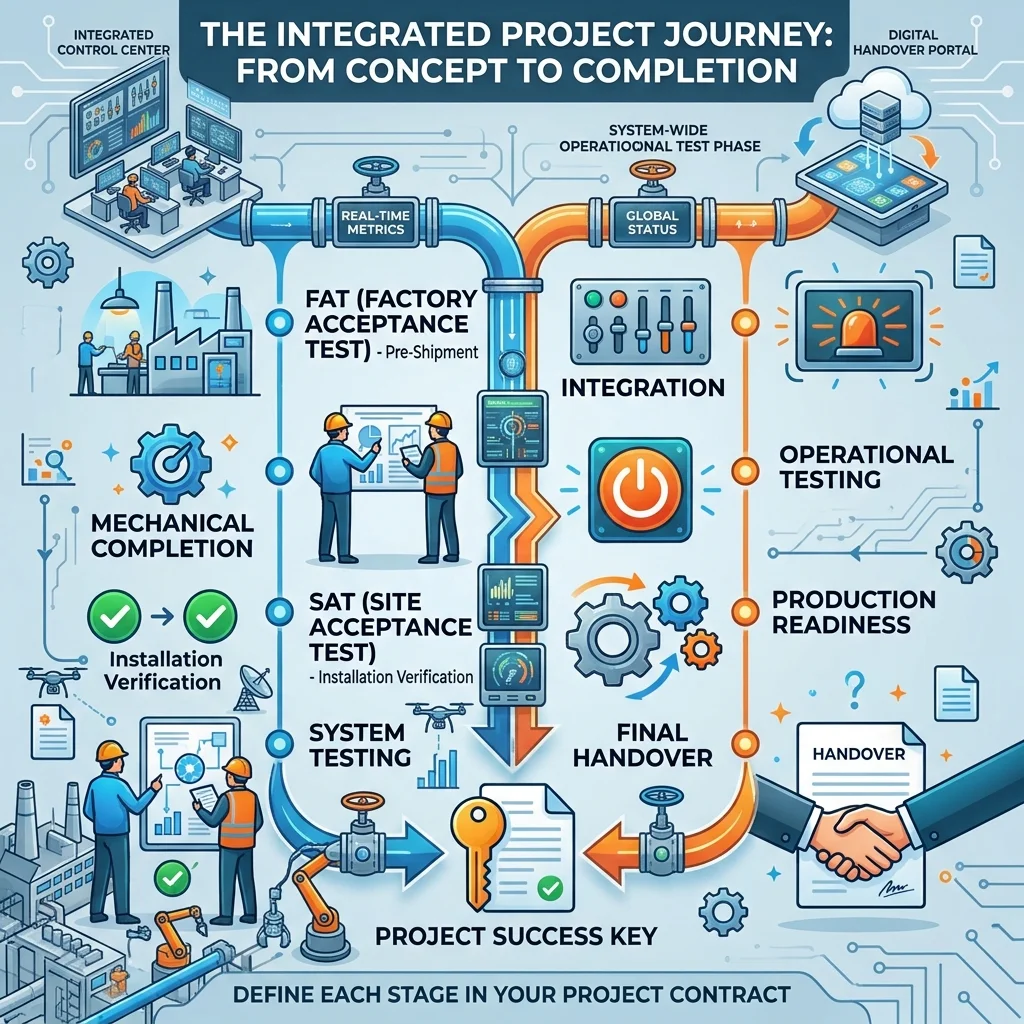
Several mistakes recur. Using “commissioning” and “start-up” without defining them. Skipping the FAT and discovering faults at site. Treating a SAT as a formality. Leaving utilities and cleaning circuits until last. Scheduling the stage with no buffer for defects. Failing to plan training and documentation. And handing over without a closed or owned list of outstanding items.
Five Questions to Ask Before You Sign
Before approving a scope, ask:
- How are commissioning, start-up and handover defined, and what closes each?
- Which tests are done at the factory and which on site, and who witnesses them?
- Who owns the integrated plan across suppliers and trades?
- How are defects classified, cleared and retested?
- What documentation and training come with handover?
FAQ: Commissioning vs Start-Up
What is the difference between commissioning and start-up?
Usage varies. Some sources treat them as the same live stage; others define commissioning as verifying that installed systems work as designed and start-up as introducing process material to reach first production. Define the terms in your contract.
What is the difference between FAT and SAT?
A FAT is performed at the supplier’s premises before shipment to verify build, controls and basic performance. A SAT is performed at the customer’s site to validate performance with real interfaces and operating conditions.
What is mechanical completion?
It is the point at which construction and installation are complete and documented, typically confirmed by a certificate and a list of outstanding deficiencies, before pre-commissioning begins.
What should a handover package include?
As-built drawings, test records and certificates, manuals, spare parts information, software and backups, training records and a list of outstanding items with owners.
Plan the Live Stages With the Project, Not After It
The simplest way to protect a project is to define commissioning vs start-up early and plan it with the same care as installation. If you are building a new line, an expansion or an upgrade and want an engineering team to discuss commissioning scope, testing and handover, read about our commissioning service or contact our engineering team to talk through your project.