
Address
6. October, Cairo, Egypt

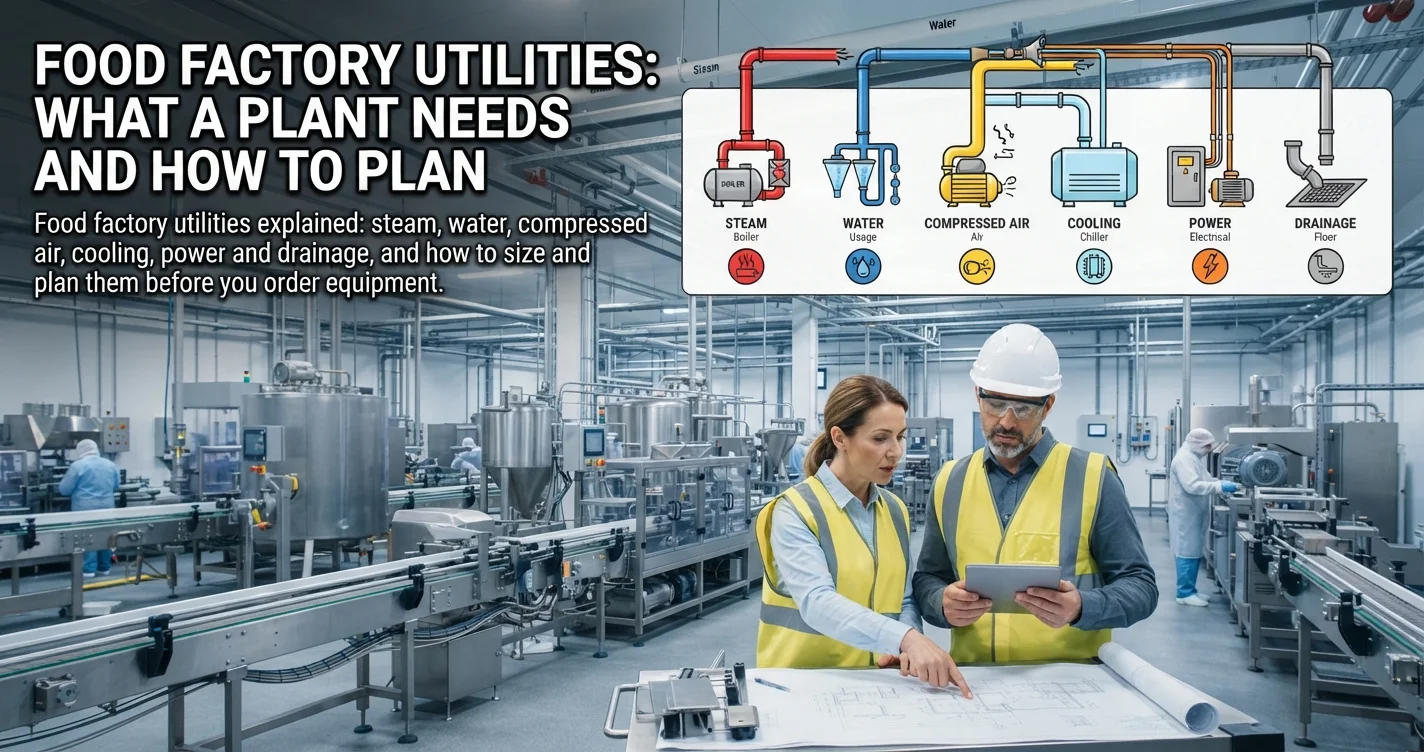

Visitors to a food plant look at the machines. Engineers look at what feeds them. Steam, water, compressed air, chilled water, power and drainage rarely appear in a brochure, yet when a line underperforms, the cause is surprisingly often something in the utility room rather than on the production floor. Getting food factory utilities right is one of the least glamorous and most valuable things a project team can do.
This guide explains what food factory utilities are, which systems a food or beverage plant typically needs, how they interact, and how to plan them before equipment is ordered. It is written for owners, plant managers and project engineers who are building, expanding or upgrading a process facility and want a clear picture of what the supporting systems involve.
What Counts as Food Factory Utilities?
In a process plant, utilities are the services that enable production without becoming part of the product. Food factory utilities usually include steam and hot water, water of several qualities, compressed air, chilled water and refrigeration, electrical power, and drainage and wastewater handling. Cleaning systems, usually CIP, sit between utilities and process: they consume hot water, chemicals, steam and power, and they depend on well-planned drains.
The boundary is not rigid. Some projects treat ventilation, gas supply or nitrogen as utilities, and some treat CIP as part of the process line. What matters is that each service has a defined source, a distribution route, a capacity and an owner. Our industrial utilities page describes how these systems are covered in an engineering scope.
Food Factory Utilities Start With the Process, Not the Boiler
A common mistake is to size utilities from the building outward: install a boiler, a compressor and a chiller of the usual size, and hope. Good planning of food factory utilities works the other way round. Begin with the process flow and ask, at each step, what service is needed, at what pressure and temperature, for how long, and how often.
A juice line, for example, needs heat for pasteurization, chilled storage, air for valves and packaging, water for rinsing and cleaning, and power for pumps and controls, but the timing of those demands differs. A dairy line has different heating and cooling patterns again. Two plants with the same nominal throughput can have very different utility profiles depending on products, batch sizes and cleaning frequency. That is why a utility schedule per machine, produced early and checked against the process flow, is the foundation of every sound utilities design.
The Core Systems in Food Factory Utilities
Steam and hot water
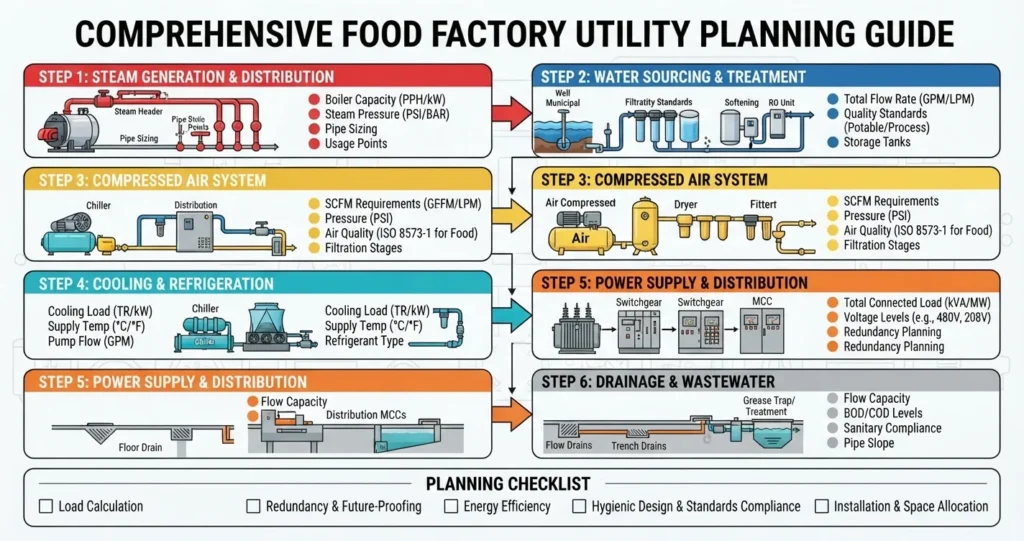
Within food factory utilities, steam is the workhorse for heating, pasteurization, evaporation, sterilization and many cleaning duties. Planning it means more than choosing a boiler. The team needs the total and peak demand, the pressure and temperature required at each point of use, the condensate return arrangement, feed-water treatment and the distribution layout. Peak demand matters because a plant tends to fail when pasteurization, cleaning and start-up heating coincide.
Steam that touches food or food-contact surfaces has different quality expectations from steam used purely for heating, so the team should identify early which points of use fall into which category and agree the requirements with the quality department. Hot water follows a similar logic: for process, cleaning and utility uses it should be planned with the actual cleaning programme in mind, not just a nominal figure.
Water: potable, process and treated
In food factory utilities, water appears in several roles: as an ingredient, as a process medium, for cleaning, for cooling and for boiler feed. Each role may call for different quality. Ingredient and food-contact water must meet drinking-water expectations and any product-specific requirements, while boiler feed and cooling water have their own treatment needs. Planning food factory utilities means identifying each use, confirming the quality required, deciding how the water will be treated, and sizing storage so that a supply interruption does not stop the plant. Treatment, storage and distribution all need space, which is why they belong in the early layout.
Compressed air
Within food factory utilities, compressed air drives valves and actuators, conveys product, operates packaging machines and sometimes contacts food directly. That last use is the one that calls for care. The British Compressed Air Society publishes a Food and Beverage Grade Compressed Air Best Practice Guideline, BPG 102, which expands on the provisions in the BRC food safety standard, ISO 22000 and ISO/TS 22002-1 and identifies air purity requirements for both direct and indirect product contact. It relates those requirements to the purity classes of ISO 8573-1:2010, the international standard for compressed-air contaminants. The guideline is a voluntary code of practice, not a legal requirement, as described in an Air Best Practices article on using ISO 8573-1.
The practical point for food factory utilities planning is to map where compressed air is used, decide which uses touch product or packaging, and specify treatment accordingly, rather than treating all air as one system. Your quality team and customers’ requirements should set the target, and the compressor, dryers and filters should follow from it.
Chilled water and refrigeration
Cooling duties in food factory utilities range from product chilling and cold storage to cooling of process equipment, condensers and compressors. Plan the cooling load, the temperature levels required, the distribution loops and the heat rejection. Chilled water demand often peaks when the plant is busiest, and cooling capacity added late is expensive. If you expect to expand, leave space and connection points.
Electrical power and backup
Power planning for food factory utilities covers the incoming supply, the main distribution, motor control centres, cabling routes and the control and instrumentation supply. It also covers decisions about backup: which loads must keep running through an outage, which can stop safely, and what happens to product in process when the power fails. A line that cannot shut down safely can lose more than the outage itself. Power data also feeds into energy and cost monitoring systems, which become much easier to implement when metering points are planned with the utilities rather than added afterwards.
Drainage, wastewater and ventilation
Food plants wash down, which shapes food factory utilities more than most people expect. Drainage, floor falls, trench drains, collection and wastewater handling must cope with cleaning volumes, hot liquids and product residues, and local discharge requirements apply. Ventilation and air handling influence temperature, humidity and hygiene zoning. These are building services, but they interact with process decisions, which is why they appear in every thorough utilities plan.
How Food Factory Utilities Interact?
The systems that make up food factory utilities do not operate in isolation, and some of the worst problems arise at the interfaces. Steam production depends on treated water. Chillers reject heat through cooling water. Compressed-air compressors generate heat and need cooling. CIP draws on hot water, steam, chemicals and power in the same minutes that production may be demanding them. A plant whose utilities were each sized sensibly in isolation can still be short at the moments when several peak together.
That is why, for food factory utilities, load profiles matter more than nameplate figures. Estimate how demands overlap over a typical day, including start-up and cleaning, and size for realistic peaks with reasonable margin. If measured data from an existing plant is available, use it. Guessing is cheaper than measuring, until the guess turns out to be wrong.
Planning Food Factory Utilities: A Practical Sequence
A workable sequence for food factory utilities planning looks like this. First, define the process flow and the product range. Second, build a utility schedule listing what each machine and area consumes, with pressure, temperature and duty. Third, aggregate the demands into load profiles, and decide the capacity of each source with a stated margin and growth allowance. Fourth, decide the quality requirements for water, steam and air in agreement with the quality team. Fifth, design the distribution routes and tie-in points, and check them against the building layout. Sixth, plan commissioning and handover so that each utility can be tested before the line depends on it.
Done in this order, food factory utilities planning also produces the documents installers need: schedules, drawings and tie-in lists. Our guide to production line installation shows how those documents feed into site readiness, and our commissioning page explains how each utility is tested.
Distribution: Where Utilities Meet Process Piping
Even perfectly sized food factory utilities fail if the distribution is poorly designed. Steam lines need proper support, insulation, drainage of condensate and safe routing. Water and CIP lines need materials and layouts suitable for their duty. Compressed-air lines need slopes and drain points. Electrical routes need segregation from wet or hot areas and capacity for future cables. Process piping carrying product has additional hygiene requirements and should not be confused with utility piping. Our mechanical, electrical and piping page explains how these scopes are organised.
Across juice, preserved-food and dairy projects where our scope has included utilities and piping, the recurring theme has been the same: food factory utilities are easiest to get right when they are designed alongside the process, not after it.
Common Mistakes With Food Factory Utilities
Several errors recur in food factory utilities. Utilities are sized to the current line and leave no margin for growth. Peaks are ignored in favour of averages. Quality requirements for water, steam or compressed air are decided after equipment is bought. Cleaning demands are forgotten when sizing hot water and drains. The utility room is placed where it is convenient rather than where distribution is efficient. And utilities are left to a separate contractor with no coordination against the process equipment.
None of these is a failure of technology. They are failures of sequence, and each is avoidable by planning food factory utilities at the same time as the process.
Five Questions to Ask Before You Commit
Before approving a utilities design, ask:
- Has every machine’s consumption been listed, with pressure, temperature and duty?
- Are peak, overlapping demands included, not just averages?
- Are water, steam and compressed-air quality requirements agreed with quality?
- Is there margin for growth, and space and tie-ins for expansion?
- Who owns the interface between utilities, process equipment and controls?
An unclear answer to any of these suggests the plan for food factory utilities needs more work.
FAQ: Food Factory Utilities
What utilities does a food factory need?
Typically steam and hot water, process and potable water, compressed air, chilled water or refrigeration, electrical power, and drainage and wastewater handling, with CIP supplied from several of them.
How are food factory utilities sized?
From the process flow outward: a consumption schedule for each machine, aggregated into realistic load profiles with peaks, then a stated margin for growth.
Is food-grade compressed air a legal requirement?
Guidelines such as BCAS BPG 102 are voluntary codes of practice, but food safety standards and customers may require controls on compressed air that contacts product or packaging. Confirm what applies to your plant with your quality team.
When should food factory utilities be planned in a new project?
At the start, alongside the process design, so that capacity, layout and quality requirements are settled before equipment is ordered.
Plan Your Utilities Alongside Your Process
Well-planned food factory utilities rarely get noticed, which is the point. If you are building a new line, expanding a plant or reviewing existing services, our engineering team can discuss utility scope with you alongside the process equipment. Read about our industrial utilities scope, or contact our engineering team to talk through your project.