
Address
6. October, Cairo, Egypt

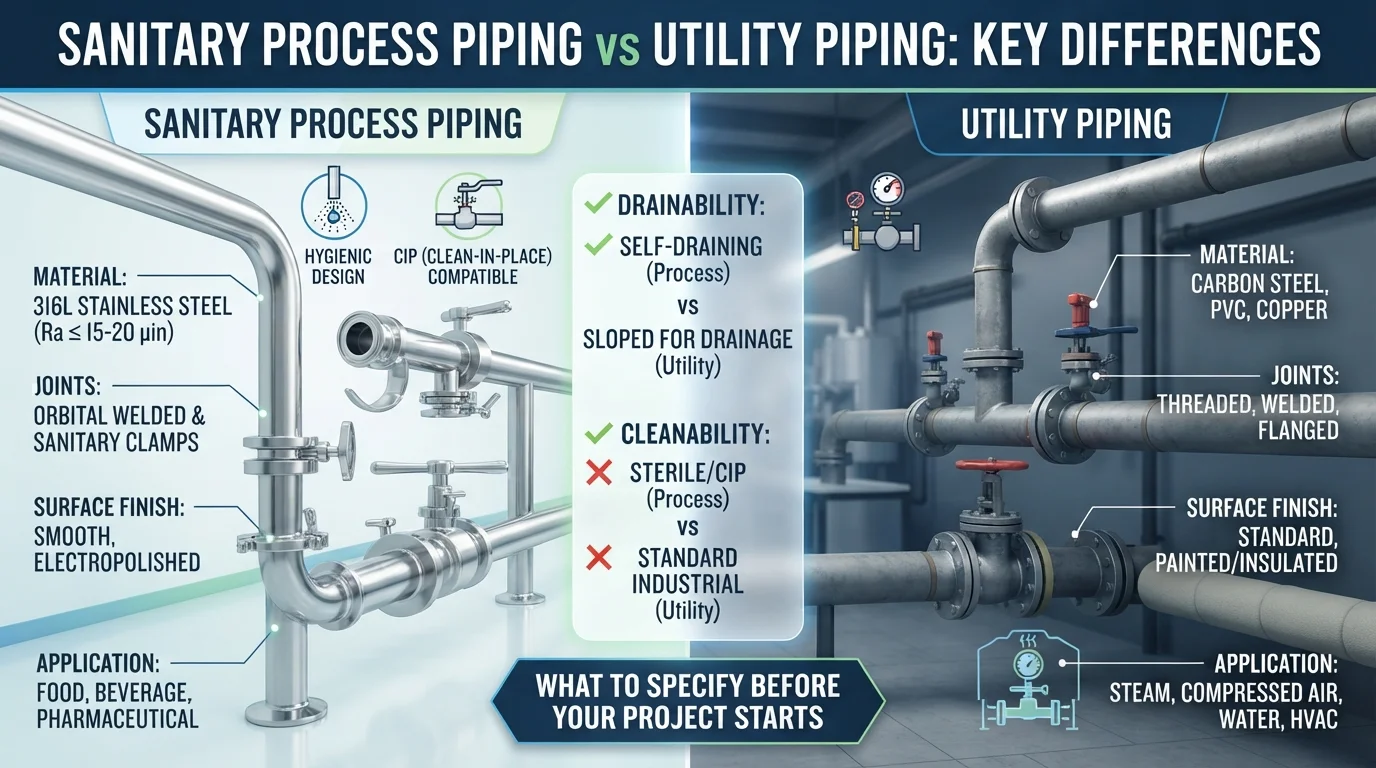

On a drawing, a pipe is a line between two points. On a food plant, two lines that look nearly identical can belong to entirely different worlds. One carries steam to a heat exchanger and will never touch a product. The other carries juice, milk or sauce, and every internal surface, weld and joint becomes part of the food safety story. Mixing up the two is a common and costly mistake, and it usually begins with the assumption that all piping is just piping.
This article explains how sanitary process piping differs from utility piping in purpose, materials, joints, drainage and cleaning, and why those differences matter when you plan a new line, an expansion or an upgrade. It is written for plant managers, project engineers and owners who need to specify, compare or supervise piping work in a food, beverage or dairy plant.
What Sanitary Process Piping Actually Is?
Sanitary process piping is the pipework that carries product, or fluids that contact product, through a food plant. It connects tanks, pumps, heat exchangers, fillers and other process equipment, and it has to do two jobs at once: move the product reliably, and stay cleanable between runs. The second job is what separates it from ordinary piping.
Because the product touches the inside of the pipe, the inside matters as much as the outside. Hygienic design treats sanitary process piping as a surface that must be smooth, free of crevices, resistant to the cleaning chemicals and temperatures used in the plant, and arranged so that it drains and can be cleaned in place. The European Hygienic Engineering & Design Group (EHEDG) sets out the broad principles in Doc. 8 on hygienic design principles, which describes the design features that make equipment and factories easier or harder to clean. These guidelines are best practice rather than law, so owners should decide with their quality teams which ones the plant will follow.
What Utility Piping Does Differently?
Utility piping serves the plant, not the product. It carries steam, hot and cold water, chilled water, compressed air, condensate, fuel gas and similar services from their source to the point of use. The fluid usually stays inside the system and never becomes part of the food.
That does not make utility piping easy. It has its own demands: pressure ratings, thermal expansion, insulation, safe routing, condensate drainage on steam, correct slopes on compressed air. But the priorities differ. For utilities, the key questions are capacity, pressure, temperature, safety and efficiency. For sanitary process piping, the key questions are cleanability, product compatibility, and the avoidance of anywhere product or cleaning solution can hide. Our industrial utilities page covers how the utility side is planned.
Sanitary Process Piping vs Utility Piping: The Main Differences
Purpose and fluid
The most basic difference is what is inside. In sanitary process piping the fluid is food, beverage or a food-contact medium, so contamination, cross-contact and cleaning residues are the primary risks. In utility piping the fluid supports the process, so leaks, pressure loss and energy loss are the primary risks. The two sets of risks lead to different design decisions from the first drawing.
Materials and surface finish
Utility piping uses a wide range of materials selected for pressure, temperature and corrosion: carbon steel, copper, various plastics and, in places, stainless steel. Sanitary process piping is typically stainless steel, chosen because it resists corrosion and can be finished to a smooth surface. Grade and finish depend on the product and the cleaning regime; acidic products, chlorides and aggressive CIP chemicals all influence the choice. The surface finish of the interior is a hygienic requirement, not a cosmetic one, because rough or damaged surfaces make cleaning harder. For tank materials in particular, see our stainless steel tanks page; the same logic extends to the pipework that connects them.
Joints, welds and couplings
In utility piping, joints are chosen for strength and tightness, and threaded or flanged connections are common. In sanitary process piping, joints are another place where product can lodge. Welds need to be smooth inside, without excess material or undercut, and removable joints need hygienic couplings that can be cleaned in place. EHEDG’s Doc. 16 on hygienic pipe couplings identifies critical design parameters for pipe couplings that are easily cleanable and sterilisable in place, impervious to micro-organisms and easy to install. The takeaway for buyers: couplings, gaskets and weld quality deserve a line in the specification, not an assumption.
Drainability and dead legs
Utility piping is designed to carry flow and to drain condensate or water at defined points. Sanitary process piping has to drain more completely, usually by gravity, so that product and cleaning solutions do not pool. It also has to avoid dead legs, the short branches where fluid stagnates. A technical article from FORCE Technology notes that EHEDG specifies the depth of a dead leg as no greater than the pipe diameter, the so-called 1D rule, and that the best hygienic design avoids dead legs altogether wherever possible. In practice this affects how branches, instrument tappings and valves are arranged in sanitary process piping, and it is one reason the layout should be designed with the process rather than added afterwards.
Cleaning
Utility piping is rarely cleaned in the sense a food plant understands. Sanitary process piping is cleaned constantly, usually in place with a CIP system that circulates cleaning solutions at controlled flow, temperature and chemical concentration. That means the piping has to be designed as part of a cleaning circuit: continuous flow paths, correct return arrangements, compatible materials and no zones the solution cannot reach. EHEDG covers this in GL 50 on hygienic design requirements for CIP installations, and our CIP systems page explains how the engineering scope is organised.
Valves, instruments and accessories
Pipes are only part of the system. Valves, pumps, sensors and sample points sit in the line and take part in the same hygiene story. A hygienic valve that drains well on a vertical pipe may trap liquid on a horizontal one; an instrument fitted into a branch can create the very dead leg the layout tried to avoid. EHEDG’s Doc. 10 on hygienic design of closed equipment for liquid food illustrates how to connect and position such equipment so that draining and cleaning in place are not obstructed. A good specification for sanitary process piping therefore names the accepted valve and fitting types and the way instruments are mounted, instead of leaving them to the installer’s habit.
Where Sanitary Process Piping and Utility Piping Meet?
The two systems are separate in purpose but linked in practice. A pasteurizer uses steam or hot water on one side and product on the other. A heat exchanger puts chilled water against product through a plate. A CIP unit draws on hot water, steam and chemicals and sends the result through sanitary process piping. These interfaces are where design discipline is tested.
At each interface, someone has to decide where the utility scope ends and the process scope begins, who supplies the connection, and what happens if a barrier fails. Many food plants separate product and utility fluids with double barriers or other arrangements, and the right choice depends on the process and the risk assessment. What matters in planning is that the interface is identified and owned, not left between two drawings.
This is also where building-style MEP experience and process-plant experience diverge. A contractor who installs piping in commercial buildings knows pressure testing, supports and insulation, but may not be used to the demands of sanitary process piping: weld quality, internal finish, drainability and CIP. Our mechanical, electrical and piping page describes how these disciplines are brought together on process projects, and it is worth asking any bidder how its experience matches your plant.
Planning Sanitary Process Piping in a Project
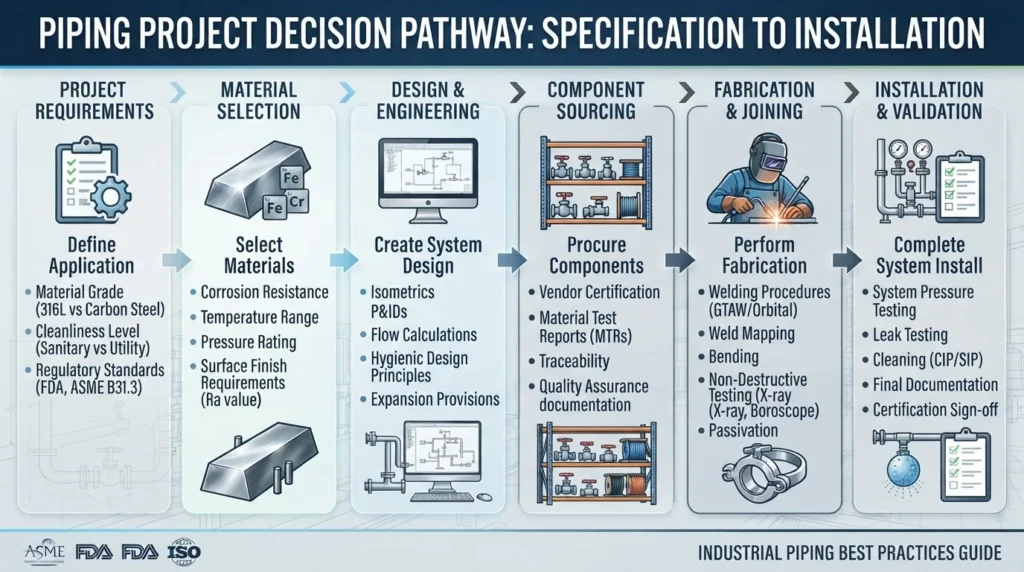
A workable approach to sanitary process piping starts early. Begin with the process flow and identify every line that touches product or cleaning solution. Classify those lines separately from utilities, and write down the specification for each class: material, finish, joint type, slope and cleaning method. Agree this specification with the quality team before the piping is detailed, not after.
Next, coordinate layout. Sanitary process piping needs routes that allow draining, access for cleaning and inspection, and clearance from heat and moisture sources. It should not be squeezed into whatever space remains after utilities, ducts and cable trays have taken their share. Reserve routes early and review them against the equipment drawings.
Finally, plan inspection and documentation. Weld records, material certificates, test results and cleaning verification build the evidence that the piping was built to specification. Commissioning should include flushing, pressure testing and CIP trials as agreed in the scope. Our commissioning page describes how that stage is organised, and our guide to production line installation covers the site readiness that precedes it.
An Illustrative Scenario
Consider a hypothetical plant adding a second product line. The utility drawings are complete: steam, chilled water and air are all sized. The product piping, however, was left to a general contractor who priced it per metre as stainless steel pipe. During installation, branches for pressure gauges are welded in at convenient points, a run is installed flat to save a support, and the CIP return is added last. At the first cleaning trial, liquid remains in the flat run and the gauge branches take longer to clear than anything else on the line. None of these faults is dramatic, but fixing them means cutting and re-welding finished work. The lesson is simple: sanitary process piping deserves its own specification, its own review and its own acceptance tests.
Common Mistakes With Sanitary Process Piping
Several mistakes recur. Treating all piping as a single package and awarding it to the lowest bidder. Specifying stainless steel but not the finish, welds or couplings. Adding branches and sensor tappings that create dead legs. Forgetting that sanitary process piping must drain, then discovering pooling after installation. Designing the CIP circuit after the piping is built. And leaving the interface between utility and process piping unowned.
None of these is exotic. Each is avoided by treating sanitary process piping as its own discipline from the outset.
Five Questions to Ask Before You Specify
Before issuing a piping specification, check:
- Which lines touch product or cleaning solution, and are they classified separately?
- Are material, finish, joint type and slope defined for each class?
- Are dead legs and drainage considered in the layout, not only in the details?
- Is the piping part of a defined CIP circuit?
- Who owns the interfaces between utility piping and sanitary process piping?
FAQ: Sanitary Process Piping
What is sanitary process piping?
It is the pipework that carries food, beverage or food-contact fluids through a plant, designed so that internal surfaces, welds and joints can be cleaned and do not harbour product.
How is sanitary process piping different from utility piping?
Utility piping carries services such as steam, water and compressed air that support production. Sanitary process piping carries product or product-contact fluids and must meet hygienic requirements for finish, joints, drainage and cleaning.
Is sanitary process piping always stainless steel?
In food and dairy plants it commonly is, but the grade, finish and joints depend on the product and cleaning regime. Confirm requirements with your quality team and the equipment suppliers.
Which standards apply to sanitary process piping?
EHEDG guidelines and other hygienic design standards are widely used as best practice. Which ones apply depends on your product, market and customers.
Get Process Piping Right From the Start
Sanitary process piping rarely gets attention until it fails, and by then the fix is expensive. If you are planning a new line, an expansion or an upgrade and want to discuss piping scope, hygiene requirements and CIP interfaces with an engineering team, you are welcome to contact our engineering team or read more about our mechanical, electrical and piping capabilities.