
Address
6. October, Cairo, Egypt

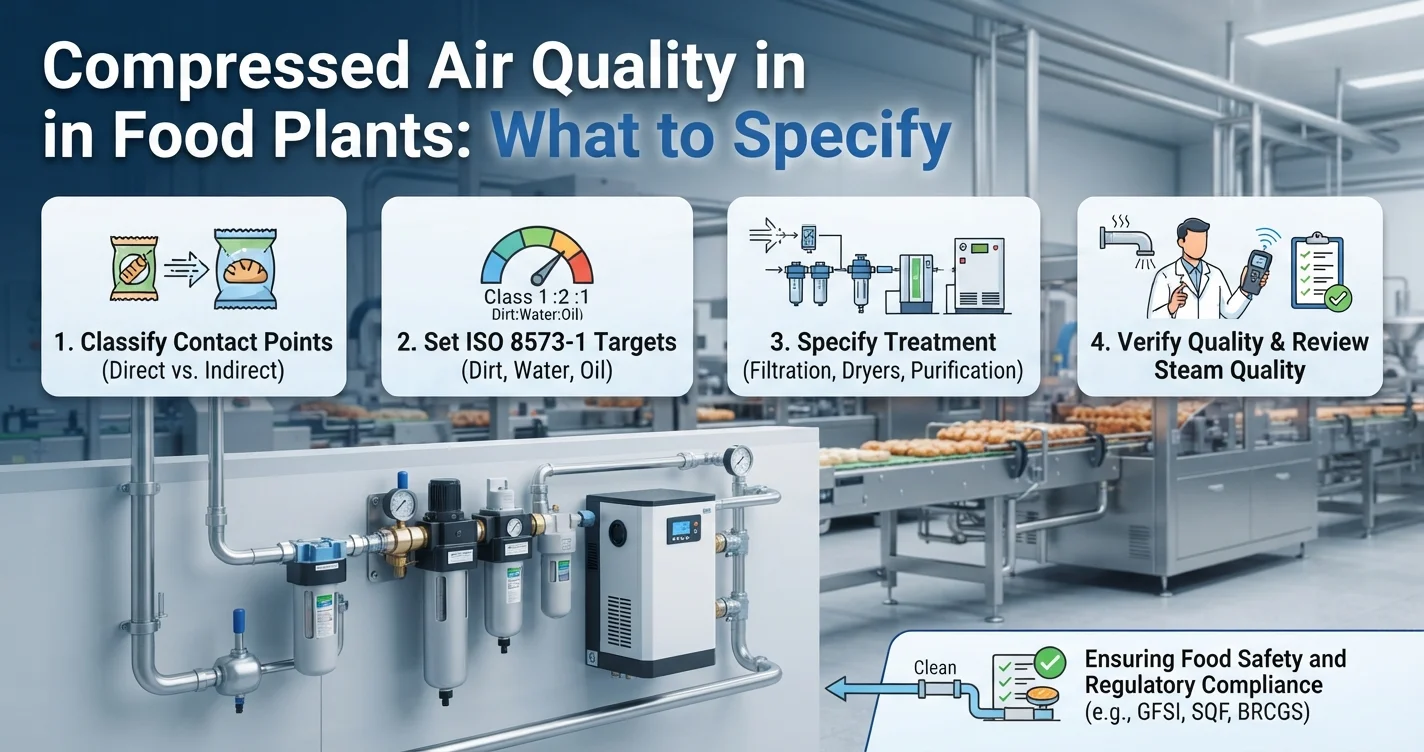

Ask a plant manager what touches the product and you will hear about stainless steel, gaskets, hands and gloves. Compressed air rarely makes the list, which is odd, because in many plants it blows across open product, drives packaging machines, conveys ingredients and cleans equipment. It is invisible, it is everywhere, and it arrives at the point of use carrying whatever the compressor, the dryer and the pipe network have failed to remove. Specifying compressed air quality deliberately, rather than inheriting whatever the utility room happens to deliver, is one of the cheapest ways to remove a hidden food safety risk.
This guide explains compressed air quality in food and beverage plants: what contaminants matter, how direct and indirect contact change the requirement, what a buyer should write into a specification, and how steam, the other utility that can touch product, fits alongside it. It builds on our overview of food factory utilities and goes deeper into the two services most often under-specified.
Why Compressed Air Quality Matters in Food Plants?
Atmospheric air is not clean. It carries dust, water vapour, traces of oil and microorganisms, and the compressor concentrates all of them. The compressed air that leaves the machine then picks up more: pipe scale, rust, condensate and lubricant residues from the system. By the time it reaches a valve or a nozzle, compressed air quality depends on every step in between.
Good compressed air quality therefore starts at the compressor but is decided at the nozzle. For a food plant the consequences range from nuisance to serious. Particles and moisture can clog equipment and contaminate packaging. Oil carry-over can taint product. Warm, wet air is a good environment for microbial growth. And where air touches food directly, it is effectively an ingredient the plant did not declare. That is why guidance on compressed air quality treats air that contacts product differently from air that only drives machinery.
The Contaminants Behind Compressed Air Quality
Industry sources group the contaminants into a short list: particles, water, oil and microorganisms. The international standard ISO 8573-1:2010 addresses the first three by defining purity classes for particles, water and oil, as explained in an Air Best Practices article on using ISO 8573-1. The same article points out two limits worth remembering. The standard does not set purity classes for microbiological contaminants, and it does not cover gases. Test methods for microorganisms are given in a separate part of the ISO 8573 series, but without specified limits.
That has a practical consequence. Compressed air quality for microbial risk is controlled indirectly, mostly by drying the air so that microbes cannot grow, filtering it at the point of use where needed, and verifying the result by testing. In short, compressed air quality is a system property, not something you buy in one box. A buyer who only writes “ISO 8573-1 class X” into a specification has covered part of the problem, not all of it.
Direct and Indirect Contact: Where the Requirement Changes
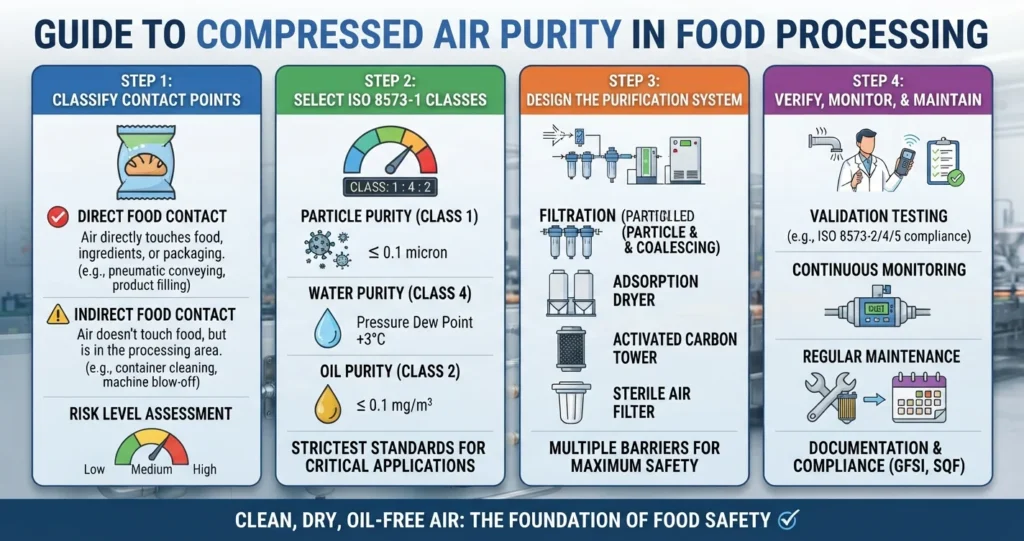
The most useful distinction in compressed air quality planning is between direct and indirect contact. Direct contact means the air strikes the product, ingredients or packaging in a way that could realistically transfer contamination. Indirect contact means the air is used near the product without hitting it, so contaminants could settle but are less likely to reach it. Compressed air that never goes near product is a third category, with the least demanding requirements.
The British Compressed Air Society publishes the Food and Beverage Grade Compressed Air Best Practice Guideline 102 for exactly this purpose. As summarised by Air Best Practices, this voluntary code of practice stipulates ISO 8573-1:2010 class [2:2:1] for air in direct contact with the product and [2:4:2] for indirect contact. A trade-press summary of the guideline adds that its humidity levels were chosen to help control microbiological contaminants and that oil limits were relaxed for indirect contact. The guideline is voluntary, so it is the plant’s own food safety system, its customers and its auditors that decide whether the classes become requirements. Treat the figures as a starting point for compressed air quality targets that you agree with your quality team, not a substitute for a documented risk assessment.
What to Specify for Compressed Air Quality?
A buyer’s specification for compressed air quality should answer five questions, in writing.
First, where is compressed air used? Walk the plant and list every point of use: product conveying, blow-off, cooling or drying of unpackaged product, packaging machines, valve actuation, tool air, cleaning. Many plants discover points of use that were never on the drawings.
Second, what does each point of use touch? Classify each as direct contact, indirect contact or non-contact, and record the reasoning. The classification drives the rest.
Third, what purity is required at each point of use? Write the compressed air quality target as a class or set of limits for particles, water and oil, with the contact category beside it, and make clear that it applies at the point of use, not only at the compressor outlet. ISO 8573-1 purity classes apply regardless of where in the system the air is specified or measured, which is why the location must be stated.
Fourth, how will compressed air quality be achieved? The treatment train usually combines the compressor type, aftercooling, drying, filtration and, where the risk calls for it, sterile filtration close to the point of use. Hengst notes that direct-contact applications typically need more stringent classes and more robust combinations of dryers and filters, especially sterile filtration at the point of use. The specification should say what is expected, and the design should show how it will be achieved.
Fifth, how will compressed air quality be verified? A Food Safety Works overview points out that processing units need a system for validating, monitoring and verifying compressed air for direct and indirect contact at a realistic frequency. In practice that means agreeing sampling locations, test methods, intervals, who performs the tests, and what happens when a result falls outside the limit.
Oil, Water and the Wet Part of Compressed Air Quality
Two choices in the compressor room shape compressed air quality more than most others. The first is oil. Oil-free compressors remove one source of contamination, while oil-lubricated machines depend on filtration to control oil carry-over, so the choice affects compressed air quality, capital cost and the risk profile. Some quality schemes also recommend food-grade lubricants where oil is present; confirm what yours requires.
The second is water, and drying is the second pillar of compressed air quality. Compressing air concentrates moisture, and cooling it condenses that moisture into liquid in the pipework. Drying controls the pressure dew point, which is what limits microbial growth and protects downstream equipment. Distribution layout matters just as much: pipes should fall to drain points, branch connections should avoid trapping condensate, and old, corroded pipework can shed rust and scale into the air stream. A plant with excellent treatment at the compressor and poor distribution can still deliver poor air at the machine.
Steam: The Other Utility That Can Touch Product
Compressed air is not the only service that can reach food. Steam is used for direct injection, cooking, peeling, blanching, and for cleaning and sterilising equipment, and when it touches product its quality matters in just the same way.
Pall’s guide to steam filtration in food manufacturing distinguishes three categories. Plant steam is used where it does not touch product, for example in heat exchangers, retorts, steam tracing or cleaning machinery. Culinary steam contacts food directly or contacts equipment surfaces exposed to product or packaging; it needs to be free of entrained contaminants, relatively dry and safe for human consumption. Clean steam, with the most demanding requirements, depends on high-quality source water, the absence of boiler additives and all-stainless steam generation and distribution. Pall identifies three quality aspects to address: condensate, boiler feed water additives and physical impurities such as rust and pipe scale.
For culinary steam, the 3-A Accepted Practice 609-03 is a widely cited US reference. A Donaldson technical article summarising it says 3-A defines culinary steam as steam free of entrained contaminants, relatively free of liquid water and suitable for direct contact with food or product-contact surfaces, and describes requirements covering safe boiler feed water, an entrainment separator ahead of the steam filter, and sanitary filter housings. Both sources are equipment vendors, so use them as explanations of the concept, and rely on the standard itself and your own regulators for requirements.
What a buyer should specify for steam mirrors the compressed air quality logic: list the points of use, classify them as plant, culinary or clean steam, set the quality target for each, and agree how the boiler, the distribution and the point-of-use treatment will deliver it. Pall also notes that boiler water chemicals carried over into steam must be compatible and safe for the end use, so involve the water treatment supplier and the quality team before the chemistry is chosen.
An Illustrative Scenario
Consider a hypothetical plant that fills and seals cartons. The line uses compressed air to open cartons, to blow-clean the filling nozzles and to drive pneumatic valves. During a quality review, the team realises the nozzle blow-off is directed at a product-contact surface just before filling, which makes it a direct-contact use, while the valve air is non-contact. The plant had one air system and one filter set for everything. The fix is not to upgrade the entire network, but to classify points of use, apply tighter treatment and point-of-use filtration to the direct-contact points, and set up periodic testing. That is a far smaller and more focused investment than treating all air to the highest standard, and it only appears because someone asked what each point of use touches. This is exactly the question a good compressed air quality specification forces.
Common Mistakes With Compressed Air Quality
A few mistakes recur. Treating compressed air quality as a generic utility matter rather than classifying points of use. Specifying a class at the compressor but not at the point of use. Ignoring distribution condition and drainage. Buying treatment equipment without a verification plan. Forgetting steam when reviewing utilities that can contact product. And leaving compressed air quality to a maintenance team without involving the quality department, who are usually the people an auditor will ask. Each of these is avoidable, and each affects compressed air quality exactly where it matters, at the point of use.
Five Questions to Ask Before You Specify
Before approving a design or a purchase, ask:
- Has every compressed-air point of use been listed and classified by contact type?
- Is the compressed air quality target written for the point of use, with a stated class or limits?
- Does the treatment train address water, oil and particles, with point-of-use filtration where risk demands it?
- Is there a validation, monitoring and verification plan with named responsibilities?
- Has the same exercise been done for steam that touches product?
FAQ: Compressed Air Quality in Food Plants
What does food-grade compressed air quality mean?
Compressed air treated and verified to a purity level suitable for contact with food, product-contact surfaces or packaging. Guidelines such as BCAS BPG 102 relate the requirement to ISO 8573-1 classes, and the right target depends on whether contact is direct or indirect.
Is there a legal standard for compressed air quality in food plants?
Guidelines such as BCAS BPG 102 are voluntary codes of practice. Food safety schemes, customers and local regulations may impose requirements, so confirm what applies to your plant with your quality team.
Does ISO 8573-1 cover microorganisms?
Not with purity classes. Test methods for microbiological contaminants exist in the ISO 8573 series, but the standard does not set limits for them, so verification and risk assessment fill the gap.
How often should compressed air quality be tested?
At a realistic frequency set by your risk assessment and quality system, with validation, monitoring and verification in place. The interval is a plant decision, so agree it with your quality team and auditors.
Do I need to treat steam as well as air?
If steam touches food or product-contact surfaces, yes. Plant, culinary and clean steam have different quality requirements, and each point of use should be classified and specified.
Specify Your Utilities Before You Buy Equipment
Good compressed air quality is mostly a matter of asking the right questions early: where is the air used, what does it touch, and how will anyone know it is clean? If you are planning a new line, an expansion or a utilities review and would like to discuss compressed air, steam and the rest of your utility scope with an engineering team, read about our industrial utilities capabilities or contact our engineering team to talk through your project.