
Address
6. October, Cairo, Egypt

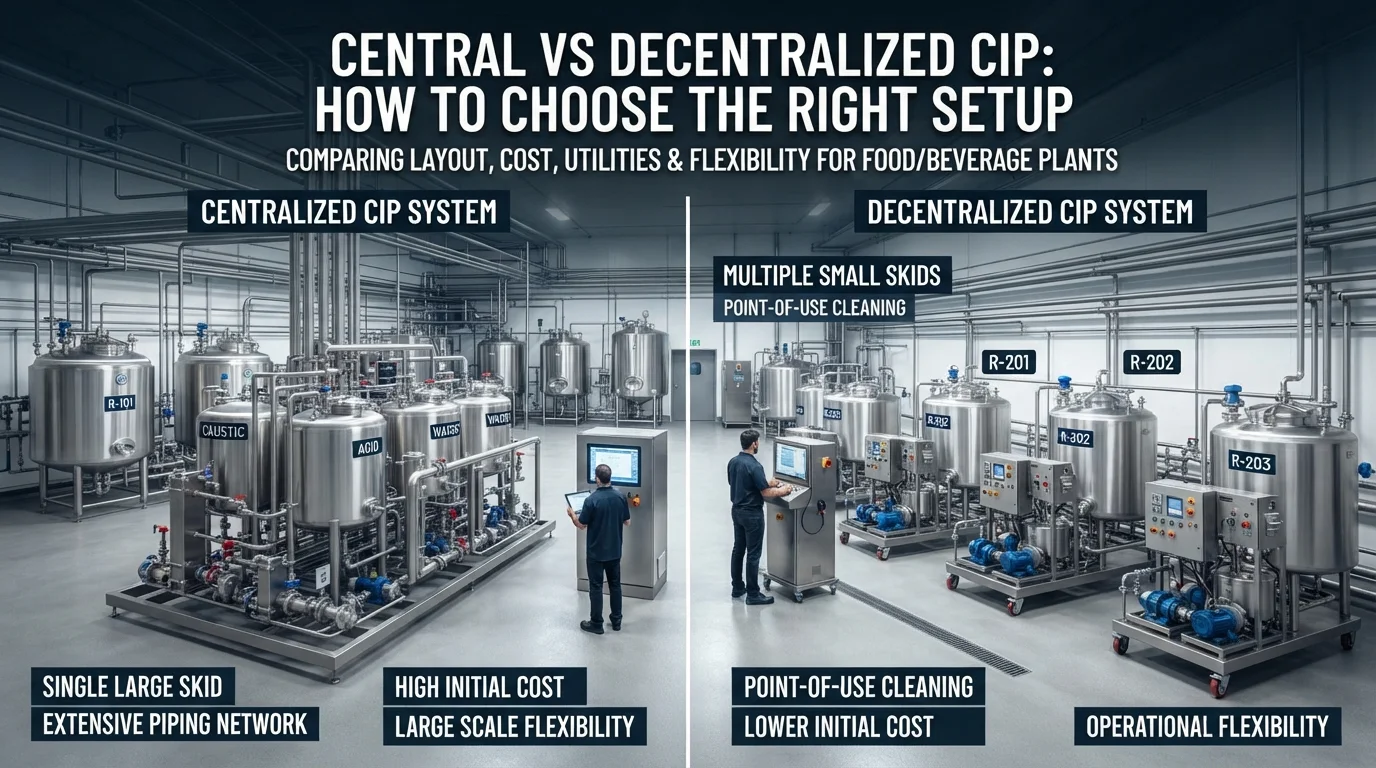

Every food plant that cleans in place eventually faces the same layout question: do we serve every circuit from one large cleaning station, or do we put smaller units close to the areas they clean? The answer shapes pipe lengths, capital cost, cleaning flexibility and how easily the plant can grow. It is also a decision that is much cheaper to make on a drawing than after the pipework is installed. Getting the choice between central and decentralized CIP right is less about technology than about the plant it serves.
This guide compares central and decentralized CIP in practical terms: how each works, where each fits, what the decision really depends on, and the mistakes to avoid. It assumes you already know the basics of cleaning in place; if not, our earlier explanation of how a CIP system works covers circuits, cycles and design drivers. It is written for plant managers, project engineers and owners who are planning a new line, an expansion or a cleaning upgrade.
Central vs Decentralized CIP: The Basic Difference
In a central arrangement, one CIP station prepares and distributes cleaning solutions to many circuits across the plant. In a decentralized CIP arrangement, several smaller units, often called satellite or standalone units, each serve a particular area or group of circuits. A guide from hygienic-process distributor CSI explains that a centralized CIP system can supply many circuits and coordinate a large number of operations from one location, while a distributed CIP system uses local dedicated systems to service individual sections of the plant. The same guide notes that transportable CIP skids can be especially useful in a distributed layout, because everything needed for cleaning sits on a compact, self-contained skid.
Neither central CIP nor decentralized CIP is better in principle. Each solves a different set of problems, and each creates its own. The task is to match the arrangement to the plant, not the other way round. Our CIP systems page describes how this scope is organised in an engineering project.
How Central CIP Works, and Where It Fits?
A central station typically holds the main cleaning solutions, such as water, caustic and acid, in tanks, with pumps, heating, dosing and controls managing delivery to each circuit. All the preparation happens in one place, so operators control one set of equipment, chemical handling is concentrated, and cleaning programmes can be managed consistently.
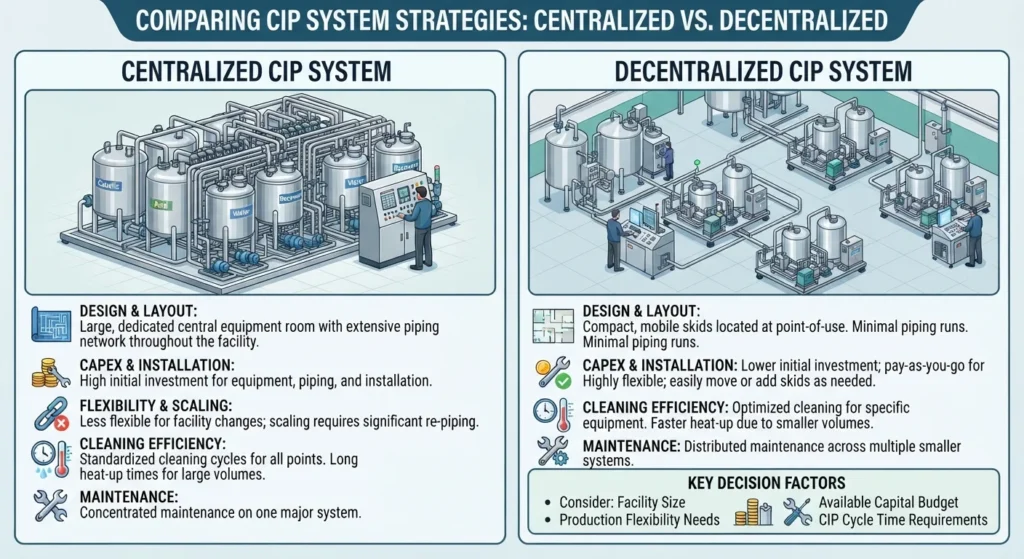
That makes central CIP attractive where the processing areas are close together and have similar cleaning needs. CSI notes that if all processing areas are relatively close and have similar cleaning requirements, a centralized system can be cost-effective, and that centralized systems tend to be larger in size and scope than distributed ones.
The weaknesses show up as the plant spreads out. Long supply and return lines mean more pipe, more volume to fill and flush, and more heat loss on the way. Several circuits calling for cleaning at the same time can overload a single station. And a fault in the central unit can stop cleaning across the whole plant.
How Decentralized CIP Works, and Where It Fits?
Decentralized CIP puts the cleaning equipment near the circuits it serves. Each unit is compact and self-contained, with its own tanks, pump, heating and controls, sized for the circuits it feeds. One article on dairy cleaning describes standalone satellite CIP units as compact, self-contained stations placed close to the equipment they serve, and calls decentralized CIP an attractive alternative for large dairies where a central station would sit very far from peripheral circuits, making heat retention and pressure difficult to maintain. It adds that standalone systems are particularly common in small to medium operations, or in sections of large plants too remote from a central station.
The advantages of decentralized CIP follow from proximity. Supply lines are short, so temperature and flow reach the circuit with less loss. Areas can be cleaned independently, which helps when lines run different products on different schedules. A unit can be added when a new line is built without redesigning the whole plant, which is why decentralized CIP suits phased expansion and retrofits. A failure in one unit affects one area, not all of them.
The trade-offs are equally real. Several units mean several sets of pumps, tanks, valves and controls to buy, maintain and verify. Chemical storage and handling may be spread across more locations. And without careful standardisation, each unit can drift into its own programme and its own habits.
Hybrid Arrangements
Plants are not forced to choose one extreme. A common compromise keeps a central station for the main areas and adds satellite units for remote or special-purpose circuits. A decentralized CIP unit might serve a distant filling hall, a line with unusual cleaning requirements or a new area added after the original plant was built, while the central station continues to serve the core process. Hybrids can capture most of the benefits of both, at the price of managing two kinds of equipment.
What the Decision Depends On?
Choosing between central and decentralized CIP is a matter of weighing several factors, none of which is decisive alone.
Layout and distance
Start with the plant plan. How far are the circuits from where a central station would sit? Long runs increase pipe cost, flush volume, heat loss and pressure drop. If the processing areas are compact and close together, a central station is easier to justify. If they are spread across buildings or floors, decentralized CIP deserves serious attention.
Simultaneous cleaning demand
Ask how many circuits need cleaning at the same time. A single station can only serve so many at once. If production lines finish shifts together and all need cleaning in the same window, a central station may become a bottleneck, and decentralized CIP removes it by providing dedicated capacity to each area.
Differences in cleaning requirements
If every area uses similar chemistry and programmes, central CIP’s single set of solutions is efficient. If areas differ, for example a dairy line with proteins and mineral scale alongside a beverage line with lighter soil, local units can be tuned to each, avoiding a lowest-common-denominator programme.
Utilities
Every decentralized CIP unit needs hot water, steam or other heating, power, compressed air and drains nearby. A central station concentrates those demands in one place; satellites spread them across the plant. The utility network has to support whichever arrangement you choose, which is why the choice should be made together with the utility design. Our industrial utilities page explains how those services are planned.
Cost: capital and operating
Capital cost depends on scale, and decentralized CIP changes the mix. Central stations tend to be bigger and need long distribution pipework; several smaller units multiply some equipment but shorten the pipework. Operating cost depends on water, chemical, heat and labour use, including the effect of long lines on heat loss and flushing. No general rule says which is cheaper; the answer comes from costing both for your layout. Treat any statement that one configuration is always cheaper with caution.
Expansion and retrofit
If the plant will grow, think about how each option copes. A central station sized for today’s plant may need upgrading when a new line arrives; a decentralized CIP unit can often be added with the new line. If you are modernising an existing plant, space and access for a large central station may simply not exist, which can make smaller units the practical choice.
Control, data and verification
Cleaning has to be controlled and verified in either case. A central station gives one control environment and one set of records. A decentralized CIP arrangement needs a standard control philosophy across units, so that programmes, alarms and data logs look the same everywhere. Our industrial automation and control page outlines how that integration is typically organised.
Hygienic design
Whichever route you choose, the installation must be hygienically designed. EHEDG’s GL 50 on hygienic design requirements for CIP installations addresses user requirement specifications and validation of CIP installations. These guidelines are best practice rather than law, so decide with your quality team which ones your plant will follow.
An Illustrative Scenario
Consider a hypothetical dairy with a processing hall, a filling hall and a new packaging building a long way from the central station. The central station sits beside the processing hall. The filling hall is served well, but the packaging building is so far away that the cleaning solution arrives cooler than intended and the return takes a long time to flush. Adding a decentralized CIP unit near the packaging building solves the problem locally, at the cost of another unit to maintain and verify. A hybrid has emerged: a central station for the core plant and a satellite for the remote area. Nothing about the situation required a redesign of the whole system, which is the practical strength of treating decentralized CIP as a tool rather than a philosophy.
Common Mistakes When Choosing a CIP Configuration
Several mistakes recur. Choosing central CIP by default without checking the distances. Choosing decentralized CIP to save on a central station without counting the cost of several units. Ignoring simultaneous demand. Forgetting that each unit needs utilities and drains. Allowing each satellite to develop its own programmes without a plant-wide standard. And deciding the CIP layout after the process pipework has been drawn, when changing it is expensive. Each of these is avoidable if central CIP and decentralized CIP are compared on the same plant drawing.
Five Questions to Ask Before You Decide
Before settling on a configuration, ask:
- How far are the circuits from each other and from a possible central station?
- How many circuits need cleaning at the same time?
- Do all areas share the same cleaning chemistry and programmes?
- Can the utilities support central or decentralized CIP at the planned locations?
- How will the plant expand, and which option copes best?
FAQ: Central vs Decentralized CIP
What is decentralized CIP?
It is an arrangement where several smaller CIP units, often called satellite or standalone units, each serve an area of the plant, instead of one central station serving all circuits.
Is decentralized CIP cheaper than central CIP?
Not automatically. It shortens pipework and can avoid an oversized central station, but multiplies equipment. Cost both options for your layout before deciding.
When is central CIP the better choice?
When the processing areas are close together and have similar cleaning requirements, a central station can be cost-effective and simple to control.
Is decentralized CIP suitable for small plants?
Often yes. One dairy-cleaning source describes standalone units as particularly common in small to medium operations, but the right answer still depends on layout, cleaning demand and utilities.
Can a plant use both?
Yes. A common hybrid uses a central station for the core plant and satellite units for remote or special areas.
Choose the Configuration Before You Build
The choice between central and decentralized CIP is easier when it is made alongside the layout, the utilities and the process design. If you are planning a new line, an expansion or a cleaning upgrade and want to discuss circuits, distances and utilities with an engineering team, read about our CIP systems scope or contact our engineering team to talk through your project.