
Address
6. October, Cairo, Egypt

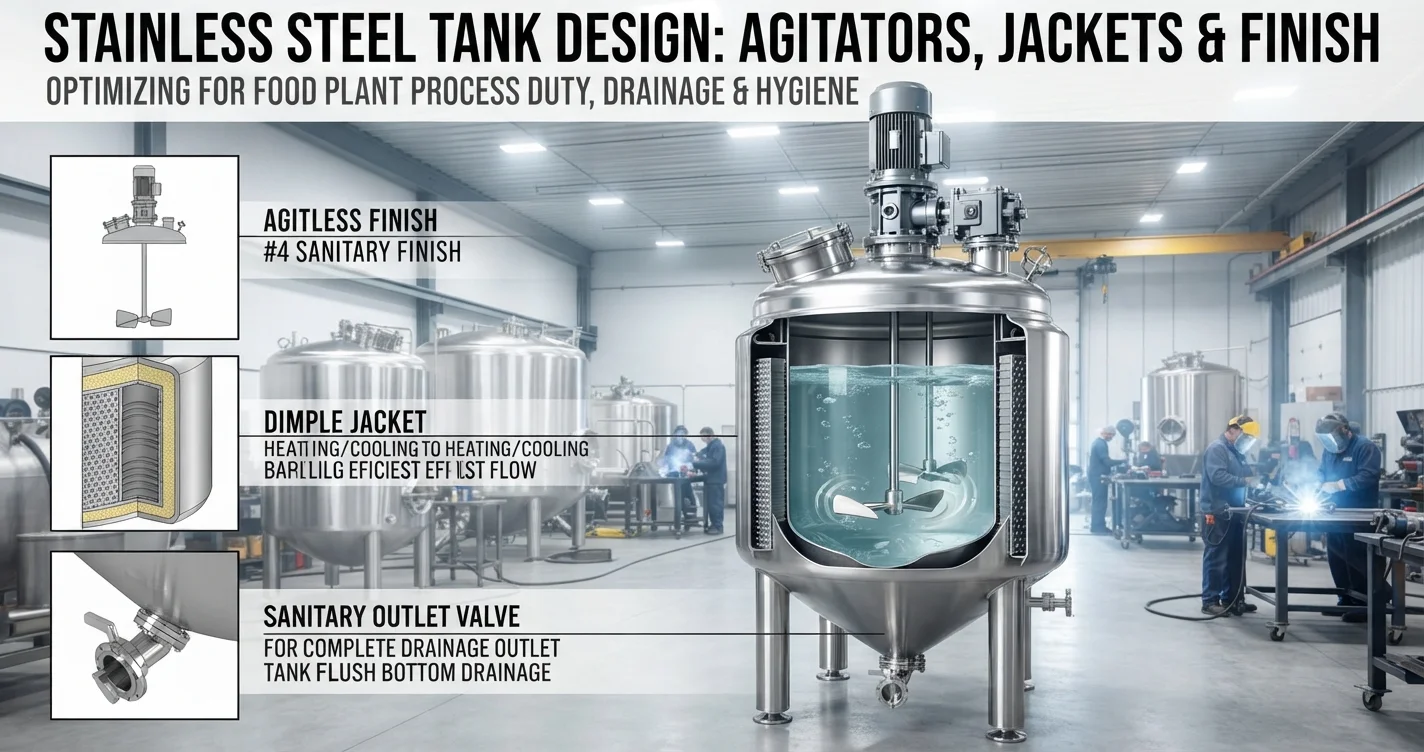

A tank looks like the simplest piece of equipment in a food plant: a vessel that holds liquid. In practice it is one of the most heavily engineered, because it has to do three jobs at the same time. It has to hold, mix or heat the product. It has to drain completely and clean reliably. And it has to connect cleanly to pipework, utilities and controls. Good stainless steel tank design keeps all three in balance, and most of the problems that appear later, from residue in a corner to an agitator seal that leaks, can be traced to a decision that was made, or skipped, on the drawing.
This guide explains stainless steel tank design for food, beverage and dairy processing: how to start from the process duty, what shape and drainage require, how agitators and jackets change the design, and why surface finish and welds matter as much as the steel. It is written for plant managers, project engineers and owners who need to specify, compare or review tanks for a production line.
What Stainless Steel Tank Design Has to Achieve
Every tank in a process plant serves a purpose beyond storage. It may buffer product between steps, blend ingredients, hold a batch while it is heated or cooled, or provide a break between machines running at different rates. Each purpose puts different demands on the vessel, and stainless steel tank design is the process of turning those demands into geometry, fittings and finishes.
At the same time, hygiene sets a second set of requirements that apply to every tank, whatever its duty. Product must be able to drain out, cleaning solution must be able to reach every internal surface, and nothing about the construction should create a crevice where residue can hide. The European Hygienic Engineering & Design Group (EHEDG) explains these principles in its Doc. 8 on hygienic design principles. EHEDG guidance is best practice rather than law, so decide with your quality team which parts your plant will follow.
Our stainless steel tanks page describes how tank fabrication is organised as part of an engineering scope; this article focuses on the design choices that make a tank work in service.
Start Stainless Steel Tank Design With the Process Duty
Before anyone chooses a shape or a supplier, define what the tank has to do. A short duty statement answers questions such as: what product will it hold, and how does the product behave (thin, viscous, particulate, foaming, heat-sensitive)? Will it be filled and emptied in batches or run continuously? Does it need mixing, and if so, how vigorous? Does it need heating or cooling, and how fast? Will it operate at atmospheric pressure or under pressure or vacuum? How will it be cleaned, and how often?
These answers drive stainless steel tank design. A buffer tank for a thin liquid needs little more than a good outlet and a spray device. A tank that blends powders into a viscous base needs an agitator sized for the duty. A tank that cooks or ferments needs temperature control. Leaving the duty vague produces a tank that either under-performs or costs more than it should, so stainless steel tank design is best started with a process engineer in the room.
Shape, Drainage and Fittings in Stainless Steel Tank Design
In stainless steel tank design, geometry is where hygiene and process meet. A vertical cylinder with a dished top and a conical or sloped bottom is a common arrangement for sanitary tanks, because the shape promotes drainage towards the outlet. The principle matters more than the specific shape: the lowest point of the tank should be the outlet, and no surface should hold liquid when the tank is emptied.
Nozzles, manways and accessories
Every opening in a tank is both a necessity and a risk in stainless steel tank design. Inlets, outlets, manways, sight glasses, level and temperature sensors, sampling points and spray devices all penetrate the shell, and each one needs thought. Position matters: connections near the bottom should drain, and branches should be short to avoid dead legs. Fittings should be hygienic types that can be cleaned in place, not general-purpose parts that happen to fit. If your plant already follows a hygienic specification for its pipework, the tank connections should match it, as described in our comparison of sanitary process piping and utility piping.
Stainless steel tank design for cleaning
Tanks are normally cleaned with spray devices fed by a CIP system, which means the design has to ensure the spray reaches every internal surface, including the underside of the agitator, the area around nozzles and the corners of the roof. That is why spray device positions, tank internals and the CIP circuit have to be considered together. Anything that casts a shadow, such as a baffle, a support or a sensor mounting, can leave a surface uncleaned. Our CIP systems page describes the cleaning side of this interface, and the flow needed for tank circuits differs from the flow needed in pipework, which is why stainless steel tank design and CIP design belong in the same conversation.
Agitators in Stainless Steel Tank Design: Mixing Without Cleaning Problems
An agitator is often the most complicated part of a tank. It brings a rotating shaft through the shell, which needs a seal, and it places moving parts inside a vessel that has to be cleaned. Good stainless steel tank design treats the agitator as part of the hygienic system, not an accessory.
In stainless steel tank design, agitators come in top-mounted, bottom-mounted and side-mounted forms. Alfa Laval’s product leaflets for its bottom-mounted agitators, such as the ALB and the EnSaLine B, describe duties such as keeping media homogeneous, dispersing powders, suspending particles and circulating media in a tank with a dimple jacket for heating or cooling. They also highlight features aimed at hygiene: a fully flushable design, seals and bearings that can be maintained from outside the tank, and a shaft connection that can be welded during installation to avoid wear parts inside the vessel. These are vendor descriptions, but they illustrate what to look for in any agitator.
Several questions belong in the stainless steel tank design specification. What does the agitator have to achieve, whether blending, suspension, dispersion or heat transfer? How will the shaft be sealed, and how will the seal be cleaned and maintained? Can seals and bearings be serviced without entering the tank? What materials contact the product, and what finish do they have? And how will the agitator be cleaned in place along with the rest of the vessel? Answering these early prevents the most common agitator problems: leaking seals, difficult maintenance and uncleaned shafts.
Jackets and Heat Transfer
When a tank has to heat or cool its contents, stainless steel tank design usually includes a jacket, a second skin through which a heating or cooling medium circulates. Several types are used. A guide from a stainless tank manufacturer describes dimple jackets, noting benefits such as improved heat transfer and lower weight and manufacturing cost, and mentions half-pipe coil jackets and conventional jackets as alternatives. Which suits a given tank depends on the temperatures, pressures, media and cleaning regime, and the supplier’s design should justify the choice.
The jacket also connects the tank to the plant’s utilities. Steam, hot water, chilled water or glycol each have their own supply and return requirements, and the tank’s performance depends on whether the utility can deliver at the needed rate. The conversation should therefore include the utility design, as described on our industrial utilities page. Insulation is another decision: a heated or cooled tank usually needs it for efficiency and for safe surfaces, while a plain storage tank may not.
Finally, consider cleaning: the jacket must tolerate the thermal cycle of production and CIP, so ask the supplier how the design handles it.
Surface Finish and Welds
Surface finish is the single most quoted number in stainless steel tank design, and also one of the most misunderstood. Roughness values, usually expressed as Ra in micrometres, describe how smooth the surface is. Rougher surfaces hold more residue and are harder to clean. Several suppliers cite an internal finish of Ra below or equal to 0.8 micrometres as the norm for hygienic food applications; Alfa Laval’s agitator leaflets list a polished hygienic food finish of Ra below 0.8, with tighter figures for ultra-pure applications, and the tank manufacturer’s guide contrasts sanitary tanks at 0.8 or better with industrial tanks at 1.6 to 3.2.
Treat those numbers as typical references, not universal requirements. The right finish depends on your product, cleaning regime and customers, and a stricter finish costs more. Specify the finish and where it applies, including welds, and ask for measurements to be recorded if verification matters.
Welds deserve as much attention in stainless steel tank design as the sheet. A rough or undercut weld inside a tank is a place where residue can lodge, so internal welds should be smooth, ground and polished to match the surrounding surface. A good specification for stainless steel tank design covers weld quality, finish, and documentation: material certificates, weld records and inspection results.
Materials in Stainless Steel Tank Design
Material choice also belongs in stainless steel tank design, usually between austenitic grades such as 304 and 316L, depending on the product, chloride content and cleaning chemicals. The choice deserves its own discussion; here, remember that grade, finish and weld treatment work together.
What to Include in a Stainless Steel Tank Design Specification
A good specification turns stainless steel tank design decisions into a document that suppliers can price and fabricate. A typical request for quotation covers capacity and geometry, material grade, connections and fittings, jacket and insulation requirements, agitator duty, surface finish and weld standards, cleaning method, utility interfaces and documentation. A reasonable starting checklist includes product type, material grade, capacity, diameter and height, and connections such as nozzles, manways and spray balls.
The specification should also say who designs the agitator, who supplies the spray devices, who connects the utilities and instruments, and who tests the finished tank. Our industrial automation and control page covers the instrument and control side.
An Illustrative Scenario
Consider a hypothetical plant ordering a tank to blend a viscous base with a powder. The specification gives the volume and the grade of steel, and little else. The supplier delivers a handsome tank with a top-mounted agitator and a flat bottom. In service, powder collects on the flat floor, the agitator shaft seal is difficult to reach, and the spray device does not clear the shadow behind a baffle. Nothing is wrong with the steel. Everything is wrong with the stainless steel tank design brief. A duty statement, a drainable bottom, an agitator seal that can be serviced from outside and a spray coverage check would have caught all three problems before fabrication. That is what disciplined stainless steel tank design adds.
Common Mistakes in Stainless Steel Tank Design
A few mistakes recur in stainless steel tank design. Specifying a tank by volume and material alone. Choosing shape for appearance or cost without checking drainage. Adding nozzles and instruments after the shell is designed, creating dead legs and cleaning shadows. Treating the agitator as an accessory instead of a hygienic component. Quoting a roughness value without saying where it applies or how it will be verified. And leaving the CIP design until after the tank is built, so that stainless steel tank design and cleaning never meet.
Five Questions to Ask Before You Order
Before approving stainless steel tank design, ask:
- Is the process duty written down, including mixing, heating and cleaning?
- Does the tank drain completely, with the outlet at the lowest point?
- Are all fittings hygienic, short and positioned to avoid dead legs?
- Can agitator seals and bearings be maintained from outside, and cleaned in place?
- Are finish, welds and documentation specified and verifiable?
FAQ: Stainless Steel Tank Design
What is stainless steel tank design?
It is the process of defining the geometry, fittings, agitation, heating or cooling, materials and finish of a tank so it performs its process duty and can be drained and cleaned reliably.
What surface finish should a food-grade stainless steel tank design specify?
Many suppliers cite an internal finish of Ra 0.8 micrometres or better for hygienic food applications, but the right requirement depends on your product, cleaning regime and customers. Confirm it with your quality team.
Does every stainless steel tank design need an agitator or a jacket?
No. A buffer tank for a thin liquid may need neither. Agitators and jackets are added when the process requires mixing or temperature control, and each adds hygienic and utility requirements.
How does tank design relate to CIP?
Tanks are normally cleaned with spray devices from a CIP system, so spray coverage, tank internals and drainage must be part of stainless steel tank design, together with the cleaning circuit.
Specify the Tank With the Process
Good stainless steel tank design starts with the process, not the catalogue. If you are planning a new line, an expansion or a replacement tank and want an engineering team to discuss duty, hygiene, utilities and cleaning with you, read about our stainless steel tanks scope or contact our engineering team to talk through your project.