
Address
6. October, Cairo, Egypt


Choosing an industrial engineering contractor is one of those decisions that feels administrative at the time and turns out to shape the whole project. The equipment gets the attention, the layout gets the meetings, but the party who coordinates the utilities, the piping, the controls and the startup will quietly decide whether the factory opens on schedule or limps into production months late.
This guide explains how to choose an industrial engineering contractor for a new factory, a production-line installation or a major upgrade. It covers the types of industrial engineering contractor you will meet, what to define before you invite bids, the criteria that actually separate one bidder from another, and the warning signs worth taking seriously. It is written from the buyer’s side of the table, for owners, investors and plant managers who will live with the result.
What an Industrial Engineering Contractor Actually Does?
The phrase covers more ground than it should, which is why comparisons go wrong. In a manufacturing project, an industrial engineering contractor is the organisation responsible for turning a process design and a set of equipment into a working, connected plant. That usually means engineering and drawings, coordination of equipment from several suppliers, mechanical, electrical and piping installation, utilities, controls integration, commissioning and handover.
What it does not necessarily mean is manufacturing the machines. Many contractors integrate equipment made by others, and a few combine fabrication with installation, for example in stainless tanks. The practical question is never “does this firm do everything?” but “which parts of the project will this firm be accountable for, and where does that accountability stop?”
The Types of Industrial Engineering Contractor You Will Meet
Bidders arrive wearing similar labels but offering different things. Knowing the types helps you compare like with like.
A turnkey industrial engineering contractor takes responsibility for a defined outcome, a working line or facility, and coordinates the pieces needed to reach it. In international practice this model is usually written into EPC or turnkey conditions of contract, such as the FIDIC Silver Book, formally titled the Conditions of Contract for EPC/Turnkey Projects, which places most design and delivery risk on the contractor. That arrangement can suit an owner who wants a single point of responsibility, though it also demands a carefully written scope, because disputes tend to start where scope is vague.
An installation-focused industrial engineering contractor is paid to install equipment you have already chosen. A mechanical, electrical and piping (MEP) contractor specialises in the services that connect equipment, and it matters whether their experience is in buildings or in process plants, because sanitary process piping is a different discipline from comfort-cooling ductwork. An equipment supplier may offer installation as part of a sale, usually limited to its own machine. A system integrator concentrates on controls and automation.
None of these is better by default. The right industrial engineering contractor depends on how much of the project you want to coordinate yourself. A well-staffed owner with an in-house engineering team may prefer separate specialists; an owner building a first factory often benefits from one coordinating party. Our overview of turnkey engineering explains how that single-responsibility model is typically organised.
Define Your Project Before Choosing an Industrial Engineering Contractor
Bids are only comparable if the brief is. Before approaching any industrial engineering contractor, write down what you are building and what you expect from the other side. A short brief is enough, as long as it answers the basic questions: what product and process, what planning throughput you will confirm, which site and which utility connections, what hygiene and quality expectations apply, and what outcome counts as handover.
Equally important is deciding which decisions remain yours. Do you intend to buy certain equipment directly, perhaps from a supplier you already trust? Will you appoint the civil contractor separately? Do you want the contractor to propose equipment, or to integrate equipment you specify? Each industrial engineering contractor prices differently depending on those answers, and a bidder who is guessing at them will either pad the price or leave gaps.
It also pays to be honest about your own capacity. An owner who cannot spare an engineer to review drawings and approve decisions weekly will slow even the best industrial engineering contractor. Name one person with the authority to decide, and make sure they are available.
The Criteria That Separate Bidders
Once the brief is clear, evaluate each industrial engineering contractor against the same questions. Price is one criterion, not the only one, and it is meaningless until scope has been compared.
Relevant, verifiable experience
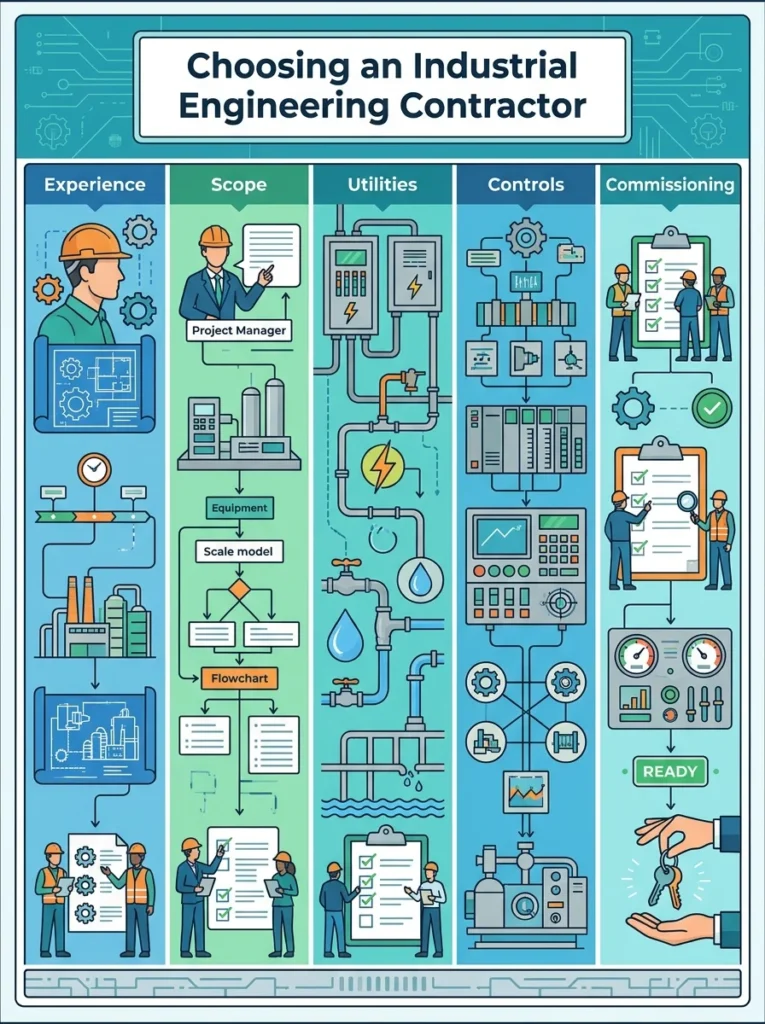
Look for an industrial engineering contractor with experience in processes similar to yours, not just a long client list. A contractor that has installed a tomato-paste line understands different problems from one that has fitted out offices. Ask what role the firm played on each reference project: did it coordinate the whole line, or install one section? Ask which parts were delivered with its own people and which were subcontracted. And ask to speak to a past client where that is possible. A reference you can phone is worth ten glossy pages.
Be cautious about logos and brand names on a website. They show that a relationship existed, not what the relationship covered. Equipment-manufacturer names in particular can mean authorised distributor, project collaborator, supplier or simply “we installed their machine”. Ask the contractor to describe the relationship plainly, and ask for anything formal in writing.
Technical depth in the disciplines that matter to you
A food or beverage plant depends on utilities, hygienic piping, tanks, cleaning systems and controls working as one. When you assess an industrial engineering contractor, check whether the people who will actually be on your project have worked in these areas. Ask who will lead the engineering, who supervises on site, and who handles controls. If every answer is “the same director”, ask how the work will be staffed when the project is busy.
On a preserved-food project involving a tomato paste and sauce line, where the scope combined collaboration with a Chinese equipment supplier, CIP and utility systems, the questions that mattered most were mundane: who owned the connection between the supplier’s engineers and the site team, and who confirmed that utilities matched the equipment’s needs? Those are the same questions to put to any industrial engineering contractor you are considering.
How scope and interfaces are handled?
A strong industrial engineering contractor talks about interfaces without prompting. They ask where your steam comes from, what the floor is made of and who is supplying the control cabinet. If a bidder’s proposal is a price and a list of equipment with no discussion of boundaries, that tells you where the problems will appear later. Our article on how to plan a turnkey food production line goes deeper into defining those boundaries.
Project control, documentation and communication
Ask how the industrial engineering contractor plans work, reports progress and manages changes. Do they issue a programme with milestones? How are drawing revisions controlled? How are variations priced and approved? An industrial engineering contractor that cannot show a sample progress report or a drawing register is probably improvising, which can still work on small jobs and rarely works on large ones.
Commissioning, training and handover
Many proposals describe installation in detail and commissioning in a sentence. Reverse that emphasis when you read them. Ask what testing the contractor performs, what acceptance criteria apply, what documentation arrives at handover and how operators will be trained. Our commissioning page describes the stage in more depth; whichever industrial engineering contractor you choose, the expectations should be written down before work starts.
Comparing Quotations Fairly
Two quotations for “the same project” are rarely the same. One includes utilities and the other assumes you supply them. One covers commissioning on water only; the other includes product trials. One lists a control system in a line item; the other leaves it to a separate vendor.
Build a simple comparison sheet before the price discussion. List the major scope items down the side and each bidder across the top, then mark who supplies, who installs and who connects. Gaps become obvious. Normalise the quotations by asking each industrial engineering contractor to price the missing items, and do not accept “to be agreed” for anything significant. If one price is far below the rest, find out why. Sometimes the contractor is more efficient; more often something has been left out.
Contract and Responsibility
Whatever the label, the contract defines what you receive. Check that it states the scope boundaries, the responsibilities of each party, the programme and how delays are handled, the acceptance and commissioning criteria, the documentation to be supplied, and the warranty and support terms after handover. Where it relies on standard conditions such as EPC or turnkey forms, have someone with legal and technical competence review how those conditions apply to your project. Terms like these allocate risk, and they can behave differently on a food plant than on the infrastructure projects they were written for.
We would also push for a clear process for changes. Projects change; the question is whether the change is agreed in writing before it is built.
Warning Signs Worth Taking Seriously
Some patterns recur often enough with an industrial engineering contractor to deserve attention. A firm date offered before the scope is understood. A price that arrives without any discussion of utilities or site conditions. Reluctance to identify the people who will run the project. References that cannot be contacted. Claims of capability that stretch across every industry from hospitals to dairies with no evidence of any of them. Certifications or approvals mentioned vaguely and never documented. None of these proves a problem, but together they are a reason to ask more questions.
Questions to Put to Every Shortlisted Contractor
Before choosing an industrial engineering contractor, ask each shortlisted firm the same five things:
- Which parts of this project will you be accountable for, and which will you not?
- Who will lead engineering and who will supervise on site?
- Which comparable projects can you describe, and can we speak to the client?
- How do you manage drawings, changes and progress reporting?
- What does commissioning and handover include, in writing?
The quality of the answers, and the willingness to give them, usually tells you more than the brochure.
FAQ: Choosing an Industrial Engineering Contractor
What should I look for in an industrial engineering contractor?
Relevant verifiable experience, technical depth in the disciplines your plant needs, a clear approach to scope and interfaces, disciplined project control and a documented commissioning and handover process.
Is the cheapest industrial engineering contractor a bad choice?
Not automatically, but price only means something when scope is identical. A low quotation can reflect efficiency or omissions, so compare what each bid includes before comparing totals.
Should I hire one industrial engineering contractor or several specialists?
It depends on how much coordination you can handle. One coordinating party simplifies responsibility; several specialists give more control but leave interface management with you.
How can I verify an industrial engineering contractor’s claims?
Ask for the specific role played on each reference project, speak to past clients and ask for any formal partner or supplier relationships to be documented.
Start the Conversation With Clear Requirements
The best way to choose an industrial engineering contractor is to arrive with a clear brief and a short list of hard questions. If you are planning a new facility, a production-line installation or an upgrade and would like to discuss scope with an engineering team, you are welcome to contact Electro Mechanic or read more about our production line installation and industrial utilities capabilities before you do.