
Address
6. October, Cairo, Egypt

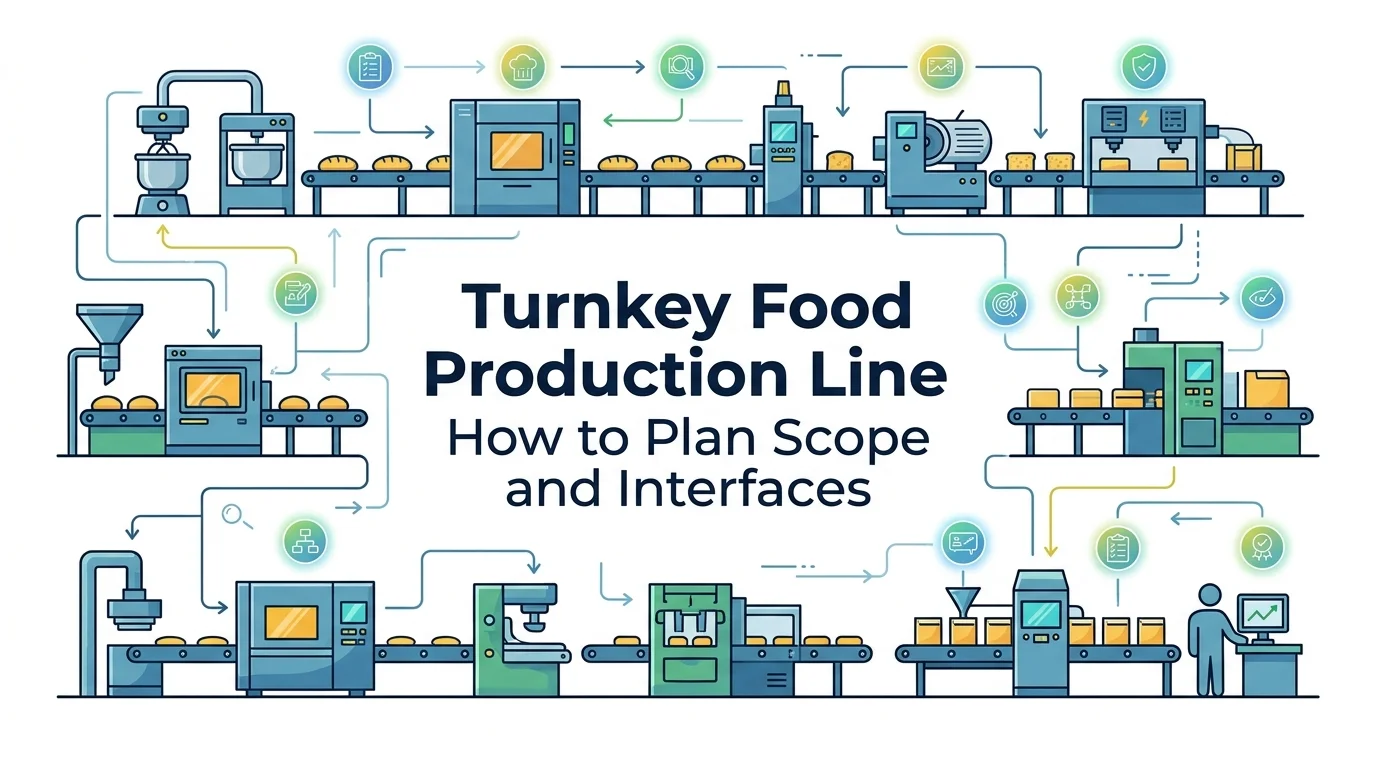

A turnkey food production line looks simple on a quotation: one contractor, one price, one handover date. On site it is a different story. Somewhere between the process equipment, the steam header, the stainless piping and the control cabinet, a gap opens that nobody was clearly assigned to close. Most delays and disputes on a turnkey food production line start in that gap, not in any single machine.
This guide is for factory owners, plant managers and project engineers who are about to plan a turnkey food production line and want to understand where the scope really begins and ends. It explains what a turnkey project should include, how to define responsibilities, and which interfaces deserve the most attention before anyone signs a contract.
What a Turnkey Food Production Line Actually Includes?
“Turnkey” describes how responsibility is organised, not what is inside the project. A turnkey food production line means one party takes responsibility for delivering a working line: engineering, equipment coordination, installation, commissioning and handover, against a scope the owner has agreed in writing. The owner turns the key and production starts.
What sits inside that scope varies from project to project, and it is worth saying plainly that no two are identical. A juice line, a tomato-paste plant and a dairy line share the same discipline but not the same equipment. Some owners buy the main process machines directly from manufacturers and ask the turnkey contractor to integrate everything around them. Others want the contractor to coordinate the full package. Both are legitimate ways to run a turnkey food production line; the problem begins only when the contract does not say which one applies.
In practice a complete turnkey food production line is built from five layers: the process equipment itself, the stainless steel tanks and vessels that hold product, the process piping that connects them, the industrial utilities that feed them (steam, water, compressed air, chilled water and electrical power), and the automation and control system that makes the whole line behave as one machine. Cleaning systems, usually CIP, cut across all five.
Why Planning a Turnkey Food Production Line Starts With the Product?
Equipment lists tempt people planning a turnkey food production line to begin with machines. Experienced engineers begin with the product and the process.
What are you making, at what volume, in how many variants, and how often will you change over? A plant that runs one product for months has different needs from one that switches between recipes daily. Changeover frequency alone changes the number of tanks, the CIP design, the valve arrangement and the control logic. If these questions are answered late, the turnkey food production line gets redesigned around the answers, usually after equipment has been ordered.
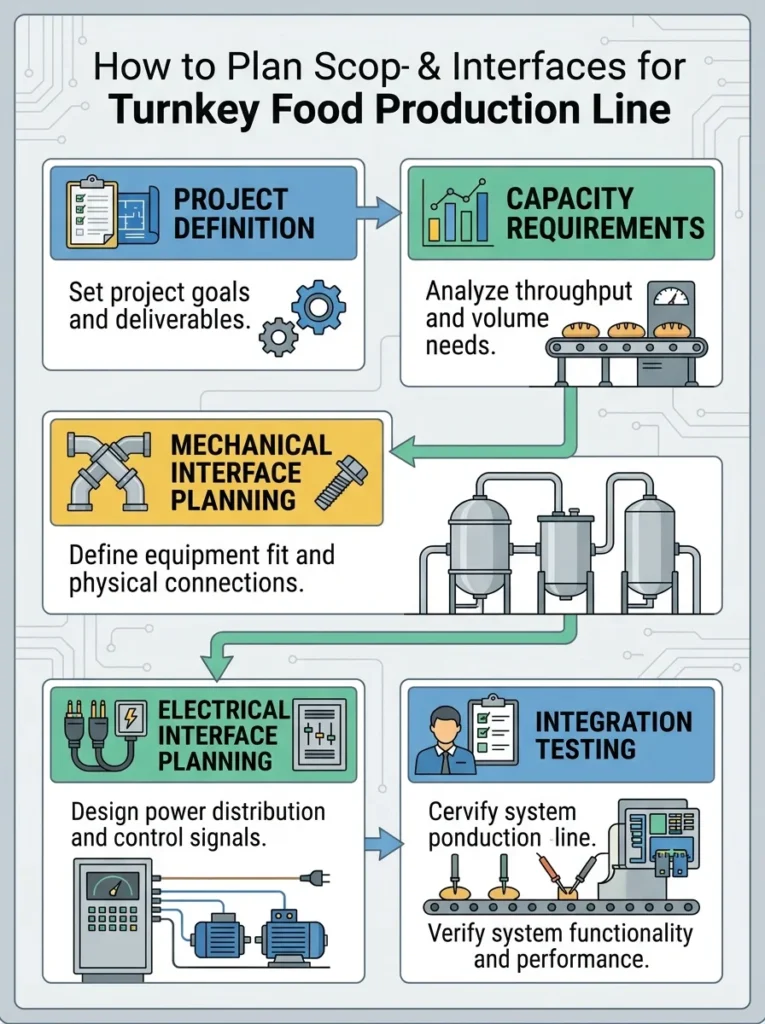
We find it useful to write the process down as a flow before discussing any supplier: raw material reception, preparation, treatment, intermediate storage, filling or packing, cleaning. Each box in that flow becomes a scope item, and each arrow becomes an interface. That simple drawing is the backbone of the whole turnkey food production line plan, and it is far cheaper to correct on paper than on site.
A sensible planning brief for the contractor covers a short set of facts:
- the product range and the process steps it needs
- the target throughput, stated as a planning figure the owner confirms
- the available site, building and utility connections
- the hygiene and quality expectations the plant must meet
- the commissioning and handover outcome expected
Notice that none of these is a machine. Machines follow from them.
Defining Scope: Who Supplies, Who Installs, Who Connects
Scope documents fail in one predictable way: they describe items but not boundaries. “Supply of pasteurizer” is an item. “Pasteurizer delivered to site, positioned, connected to steam, product and CIP lines, and tested with water” is a boundary. Boundaries are what a turnkey food production line contract needs.
Process equipment and its boundaries
When equipment comes from several manufacturers, usually the case with imported lines, someone has to own the connections between them. Who receives the shipment and checks it against the packing list? Who positions and anchors the equipment? Who supplies the skids, platforms and supports? Who confirms the connection points on the manufacturer’s drawings match the connection points on the site drawings?
On a juice and soft-drink line we installed in Egypt, the package combined imported process equipment with locally coordinated stainless steel tanks, utilities and piping, followed by commissioning and operator training. The lesson we took from it is general rather than specific: the equipment drawings were only useful once someone reconciled them with the building, and that reconciliation is engineering work that belongs in the scope, not in the margins.
Utilities and process piping
Utilities are where an optimistic budget usually breaks on a turnkey food production line. A turnkey food production line may be well specified on the process side and still stall because the boiler cannot carry the steam load, the compressed-air plant is undersized, or the chilled-water loop was never extended to the new hall.
Ask for a utility schedule early: what each machine consumes, at what pressure and temperature, and where it connects. Compare that schedule against what the site can actually deliver. If the answer is “it can’t”, better to learn it during planning than during startup. The same discipline applies to process piping. Sanitary piping carrying product is not the same job as utility piping carrying steam or water, and a contractor who treats them identically will surprise you later. If you want to see how we think about this boundary, our mechanical, electrical and piping and industrial utilities pages describe the scope areas in more detail.
Controls and automation
Controls tend to be treated as an afterthought, then discovered to be the longest lead item. Decide early whether the line will run from machine-level controllers talking to a central PLC, from a supervisory system, or from some mix. Agree who writes the control logic, who documents it, and who owns the alarm and recipe structure afterwards. For a turnkey food production line, the controls scope should also say how the line’s data reaches the people who manage it. Our industrial automation and control page outlines how that work is typically organised.
Interfaces: Where a Turnkey Food Production Line Succeeds or Fails
An interface is any point where responsibility passes from one party, discipline or piece of equipment to another. A turnkey food production line has dozens. Four deserve special attention.
The first is mechanical: where the equipment skid meets the piping. Misaligned flanges, wrong connection standards and missing drain points are small errors with large schedule consequences. The second is electrical: motor power, instrument signals and safety circuits, each with a defined start and end. The third is utility: every consumer needs a tie-in point, and every tie-in point needs an owner. The fourth is the interface between design and the building itself: floor falls, drains, openings, access for rigging and room for maintenance.
Hygienic design and CIP in a turnkey food production line
Cleaning is the interface people most often under-plan. In a hygienic plant, cleanability is not a feature added at the end; it shapes the layout of tanks and pipework from the start. Industry guidance on this is substantial. The European Hygienic Engineering & Design Group (EHEDG) publishes hygienic design principles in its Doc. 8, which describes how poorly designed equipment and factories become difficult to clean. It also publishes GL 50 on hygienic design requirements for CIP installations, covering user requirement specifications and validation of CIP installations. These guidelines are widely used as best practice rather than as law, so the owner should decide which, if any, apply to the turnkey food production line and write that decision into the specification.
Practically, this means asking where the CIP supply and return lines connect, whether every tank and pipe run can be drained and reached by the cleaning circuit, and who commissions the CIP cycles. Our CIP systems page covers the scope we typically coordinate; what applies to your plant depends on the product and the standards your customers expect.
Planning the Sequence: Design, Installation and Commissioning
A credible plan for a turnkey food production line moves through stages, and each stage has an exit condition rather than only a date.
Engineering comes first: the process flow, equipment layout, utility schedule, piping drawings and control philosophy. Only when these are agreed does procurement make sense. Installation follows, and here the sequence matters as much as the work. Civil and utility preparation need to be ready before equipment arrives, a point we expand on in our guide to production line installation. Equipment is positioned, piping is installed and tested, electrical and control cabinets are connected, and only then does anyone start powering things up.
Commissioning is not the same as installation, and a good plan treats them as separate stages with separate acceptance points. On a turnkey food production line, commissioning checks that each system works on its own, then that the systems work together, usually first on water and then on product. Operator training belongs here too: the people who will run the turnkey food production line every day should learn it while the engineers who built it are still on site. Our commissioning page describes this stage in more depth.
One caution about timelines. Any contractor who gives you a firm date before the scope, utilities and equipment sources are clear is guessing. Treat early schedules as ranges until engineering has progressed.
Responsibilities: What the Owner Still Has to Decide
A turnkey food production line does not mean hands-off. Some decisions can only come from the owner, and projects stall when they arrive late. The owner usually decides the product mix and future flexibility, the quality and hygiene expectations, the site and building constraints, the approved vendors for particular equipment, and the budget range. The owner also approves the scope boundaries, so that nothing falls between the contractor’s responsibilities and the owner’s own purchases.
It also helps to name one person on each side who can say yes. Projects slow down when drawings wait for approvals that nobody is empowered to give.
Be careful, too, about assuming that every service is included. A contractor’s brochure may list engineering, installation, tanks, utilities, controls and commissioning, but your contract defines what you actually receive. Read the scope, not the brochure.
Questions to Ask Before You Sign
Before committing to a turnkey food production line contract, put these questions to every bidder:
- Which items are supplied by you, which by the owner, and which by third parties?
- Where exactly does your responsibility for each connection start and end?
- How are utilities, CIP and controls coordinated with the process equipment?
- What does commissioning include, and what are the acceptance criteria?
- What documentation and training do we receive at handover?
Clear answers usually signal a contractor who has delivered a turnkey food production line before. Vague ones are worth a follow-up meeting.
FAQ: Turnkey Food Production Line Planning
What is a turnkey food production line?
It is a production line delivered under a single responsible contractor who coordinates engineering, equipment, installation, commissioning and handover against an agreed scope. The exact scope varies, so the contract should list what is included.
What is the difference between turnkey and buying equipment separately?
When you buy separately, you manage the interfaces between suppliers yourself. With a turnkey food production line, one party coordinates them and carries responsibility for the working result within the agreed scope.
How early should utilities be planned?
During the first engineering stage. Utility capacity influences equipment selection, layout and cost, so a utility schedule should exist before equipment is ordered.
Does a turnkey contractor supply every machine?
Not necessarily. On a turnkey food production line, some projects include equipment supply; others use equipment bought by the owner and have the contractor integrate it. The scope document should say which applies.
Plan Your Turnkey Food Production Line With Our Engineering Team
A well-planned turnkey food production line is mostly the result of clear boundaries drawn early. If you are preparing a new facility, a line addition or an upgrade, our team can discuss the scope, utilities and interfaces with you before you commit to equipment. Read more about our turnkey engineering approach, or discuss your project with us.